

Your Faith Journey with EWTN
As we deepen our relationship with the Eternal Word, Jesus Christ, we grow in grace and are transformed by His love and mercy.
c. 231–c. 251
Patron Saint of nurses, breast cancer, rape victims, bakers, jewelers, bellfounders, and natural disasters

St. Agatha of Sicily lived in the mid-third century and is one of the most venerated virgin martyrs of the early Church. She was a virtuous woman with extraordinary courage and unwavering faith in Christ. She was born into a noble Christian family in Catania, Sicily, and consecrated her life to God from an early age.
During the persecution under Emperor Decius, St. Agatha’s beauty attracted the unwanted attention of a Roman official—traditionally named Quintianus—who attempted to force her into marriage. When she refused, professing that Christ alone was her spouse, she was arrested and handed over to a brothel in an attempt to break her resolve. St. Agatha remained firm, praying continuously, and was preserved from every assault on her dignity by divine assistance.
Enraged by St. Agatha’s perseverance, Quintianus ordered brutal torture. St. Agatha’s body was stretched on a rack, beaten, and mutilated by the removal of her breasts. This evil atrocity led to her patronage of women battling breast cancer.
According to tradition, St. Peter appeared to her and healed her wounds. Seeing her wounds healed, Quintianus ordered her to be rolled over hot coals. Physically depleted yet spiritually rejoicing, St. Agatha prayed.
St. Agatha died in prison around 251, offering her life for Christ. Her tomb in Catania became a place of miracles, and devotion to her spread. By the sixth century, she was commemorated in the Roman Canon, one of the earliest female martyrs to receive this honor.
St. Agatha’s witness reveals her courage, purity of heart, and profound trust in Christ. Today, her story is still inspiring Christians facing spiritual trials and temporal tribulations.
According to tradition, St. Agatha fled from Sicily during the persecution of Emperor Decius (A.D. 249–251) and found refuge in Malta. Her stay was brief, and she is believed to have spent her time in a crypt in Rabat. During her time in the crypt, she is said to have prayed and taught Christian principles to local children. She eventually felt it was her duty to return to her native Sicily to witness for her faith, even at the risk of martyrdom. The crypt she used in Malta is still revered today and is part of a complex that includes catacombs and a church dedicated to her. The Maltese people have a strong devotion to St. Agatha, and the crypt where she stayed is now a sacred site dedicated to her, the St. Agatha’s Crypt, Catacombs, and Museum complex in Rabat. She is also considered one of Malta’s patron saints.
Devotion to St. Agatha began almost immediately after her death. Her tomb in Catania became associated with miracles. By the sixth century, her name was included in the Roman Canon, which attests to the significance of her early veneration. Her name was also included in early Church calendars, appearing in them from the 500s A.D. Her veneration spread rapidly after a volcanic eruption in Sicily was attributed to her prayers, and she became known for her courage and fidelity to Christ. Two early churches were built in Rome in St. Agatha’s honor: Sant’Agata del Goti, built in the fourth century, and Sant’Agata in Trastevere, built in the eighth century. St. Agatha’s relics are buried in the Badia di Sant’Agata in Catania, a church dedicated to her. The city of Catania, her birthplace, is also one of her patronages. However, the town of Palermo also claims to be her birthplace. There are many other churches, both in Italy and elsewhere, named after St. Agatha, such as those in Malta, the Americas, and the U.K.
The most famous miracle associated with St. Agatha is the stopping of the volcanic eruption of Mount Etna in 252 A.D., the year after her martyrdom. The lava was advancing on the city of Catania, but people carried her veil in procession, and the flow miraculously halted. Spared from tragedy, the people of Catania declared St. Agatha the city’s patron saint and continued to carry the saint’s veil in procession during later eruptions. St. Agatha is also invoked for assistance during other natural disasters, including earthquakes and fires.
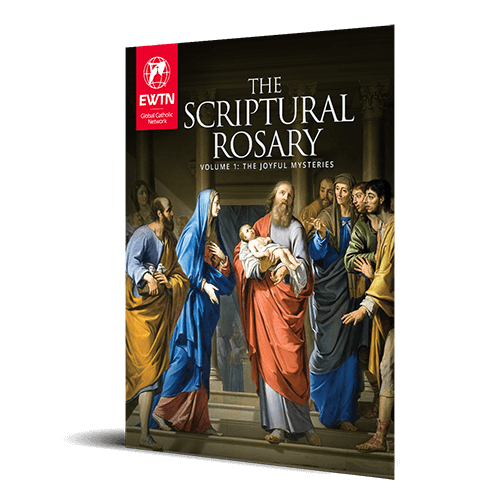
The Holy Rosary is an amazing prayer, encouraged by popes, loved by saints, and prayed by the faithful. At its heart, the Rosary is a meditation on Sacred Scripture, on the lives of Jesus and Mary.
Through this Scriptural Rosary, we hope that you will be able to better meditate on each Hail Mary and deepen your understanding of Sacred Scripture. Use the form below to get your free copy of The Scriptural Rosary.
Be inspired to follow in the footsteps of the saints. Subscribe to receive the Daily Saint, featuring a brief biography delivered to your inbox each day.
Start now and let the intercession and witness of the saints draw you closer to God.

As we deepen our relationship with the Eternal Word, Jesus Christ, we grow in grace and are transformed by His love and mercy.
STEP 1
We’re here to serve you. Let us help you complete your gift with confidence.

Send a message to Mission Advancement.

Guidance for DAFs, stock, IRA, and more.

Manage your gifts and preferences.