

Your Faith Journey with EWTN
As we deepen our relationship with the Eternal Word, Jesus Christ, we grow in grace and are transformed by His love and mercy.
c. 291–January 21, 304
Patron Saint of girls, Girl Scouts, chastity and virgins, victims of sexual abuse, betrothed couples, gardeners

St. Agnes of Rome is one of the most venerated virgin martyrs of the early Church. Her name, meaning “pure” in Greek and “lamb” in Latin, reflects both her innocence and her sacrifice for Christ.
Born around 291 to a noble Roman family, Agnes was raised in the Christian Faith during the time of intense persecution under Emperor Diocletian. From an early age, she consecrated her virginity to Christ, vowing to belong to Him alone. When wealthy suitors sought to marry her, she refused them all, saying she already had a heavenly Spouse.
Angered, one suitor accused her of being a Christian. Her accuser brought her before the authorities, who commanded her to sacrifice to pagan gods. When she refused, she was taken to a brothel, but an angel protected her. It is said her hair grew to cover her body, and a bright light around her blinded those who would attempt to defile her.
The son of the Prefect attempted to approach her and fell dead. Other accounts say he was struck blind. The Prefect blamed St. Agnes and accused her of witchcraft. When St. Agnes told him an angel was protecting her, he asked her to prove it by telling the angel to bring back his son. She knelt to pray for the young man, and he was revived.
St. Agnes was condemned to death. Accounts tell that she was thrown into the flames, but the fire would not consume her. Finally, she was beheaded around the year 304. She was buried along the Via Nomentana, and her tomb became an early pilgrimage site.
Emperor Constantine’s daughter, Constantina, credited her prayers for a miraculous healing and built a basilica in St. Agnes’s honor. She is usually depicted with a white lamb, symbolizing her innocence.
According to tradition, Emerentiana was the foster sister of St. Agnes. A few days after St. Agnes was martyred, Emerentiana was found praying at Agnes’s tomb. When she was discovered there, she was stoned to death by a pagan crowd after professing her faith and denouncing the pagans for killing Agnes. She is considered a martyr, and although she had not been baptized, the event is seen as a “baptism by blood.” The Church recognizes her as a saint and a martyr for the Faith.
An ancient Catholic tradition, the “Blessing of the Lambs,” takes place on the feast day of St. Agnes, which falls on January 21. On this day, two lambs are blessed by the pope or a bishop he designates. The lambs are shorn on Holy Thursday, and their wool is used to make pallium stoles, which are white liturgical vestments. The pallium symbolizes apostolic authority and unity with the pope, and it is given to newly consecrated archbishops. The lamb (agnus in Latin) symbolizes both her innocence and her connection to Christ, the Lamb of God.
In the fourth century, Constantia, the daughter of Emperor Constantine, was healed from leprosy after praying at St. Agnes’s tomb. In gratitude, she built the original basilica over the catacombs where St. Agnes was buried to honor her. The current church, the Basilica of St. Agnes Outside the Walls (Sant’Agnese fuori le mura), was later reconstructed and enlarged by Pope Honorius I in the seventh century and remains essentially unchanged today. The remains of St. Agnes are preserved beneath the altar at this basilica.
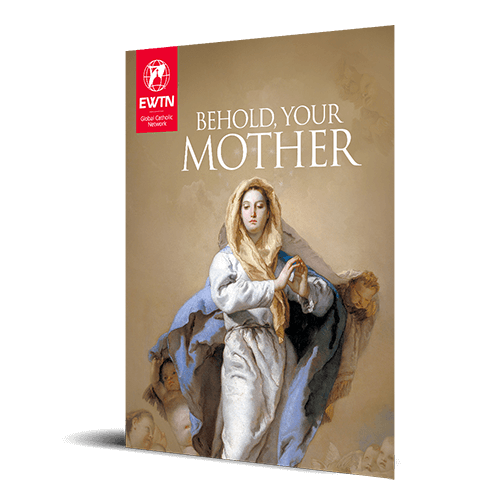
We hope this special eBook will draw you closer to our Blessed Mother and her Son, Jesus Christ. We trust that the pages will bring your heart under her mantle, as we share a few of the beautiful and befitting names bestowed upon the Blessed Virgin Mary.
Be inspired to follow in the footsteps of the saints. Subscribe to receive the Daily Saint, featuring a brief biography delivered to your inbox each day.
Start now and let the intercession and witness of the saints draw you closer to God.

As we deepen our relationship with the Eternal Word, Jesus Christ, we grow in grace and are transformed by His love and mercy.
STEP 1
We’re here to serve you. Let us help you complete your gift with confidence.

Send a message to Mission Advancement.

Guidance for DAFs, stock, IRA, and more.

Manage your gifts and preferences.