

Your Faith Journey with EWTN
As we deepen our relationship with the Eternal Word, Jesus Christ, we grow in grace and are transformed by His love and mercy.
c. 1033–April 21, 1109
Patron Saint of theologians, philosophers, scholars

St. Anselm of Canterbury stands among the most influential theologians in the history of the Church. Born around 1033 in Aosta, then part of the Kingdom of Burgundy, St. Anselm possessed a sharp intellect and a contemplative spirit from an early age.
St. Anselm entered the Benedictine abbey of Bec in Normandy, where he found both an intellectual and a spiritual home. Under the guidance of Prior Lanfranc, he excelled in theological study and teaching. He became the prior and later abbot of Bec.
During his time at Bec, Anselm composed many of his most important works, including writings on the existence and attributes of God and the mystery of redemption. His theological method emphasized the harmony between faith and reason, famously articulated in the phrase “faith seeking understanding.”
In 1093, St. Anselm was appointed Archbishop of Canterbury. His episcopacy was beset by ongoing conflict with King William II and later King Henry I over the Church’s independence, particularly regarding the appointment of bishops and the authority of the pope.
Refusing to compromise his principles, St. Anselm endured years of exile, remaining faithful to his conscience and the Church. He went into voluntary exile twice, pressuring the king to renounce his authority to appoint bishops. Recalled from exile in his later years, he worked toward reconciliation between the Church and the crown while maintaining the Church’s self-government.
St. Anselm died on April 21, 1109, and was canonized in 1494. Declared a Doctor of the Church in 1720, he left behind a prolific body of work that emphasized the use of reason to explore and understand faith.
St. Anselm of Canterbury left behind a significant body of theological and philosophical works, most notably the Proslogion, which contains the ontological argument for God’s existence; the Monologion, a meditation on the divine nature and existence of God; and Cur Deus Homo (Why God Became Man). His writings focus on “faith seeking understanding.” They include treatises on the free choice of the will, the Incarnation, logic and truth, sin and evil, the fall of the devil, Trinitarian theology, the Virgin Conception, and Original Sin. He also left behind two volumes of personal and pastoral letters, along with various devotional writings. St. Anselm’s work, heavily influenced by St. Augustine, bridged theology and logic, dominating scholastic thought for centuries.
St. Anselm of Canterbury defended the Church’s freedom against royal encroachment, asserting the independence of spiritual authority from earthly powers. He opposed the English Kings William Rufus and Henry I, refusing to accept “investiture,” meaning that the king had the right to appoint bishops and abbots and to require them to pay homage to the crown. His refusal resulted in two separate exiles. He maintained direct allegiance to Pope Urban II and Pope Paschal II, resisting the King’s desire to control the English Church independently of Rome. His willingness to accept exile rather than compromise set an enduring example of moral courage and ensured the Church’s right to appoint its own leaders.
The Investiture Controversy was a power struggle between St. Anselm, Bishop of Canterbury, and two English kings, William II and Henry I. The conflict was over the Church’s independence. The central issue was whether kings had the right to appoint bishops and abbots and require them to pay homage to the crown. As a staunch defender of clerical reform, St. Anselm maintained that only the Church could invest bishops and control Church offices. The conflict was resolved years later through a compromise: King Henry I agreed to give up the right to invest bishops with the staff and ring, symbolizing spiritual authority, while St. Anselm allowed that bishops could pay homage to the king for their temporal (earthly) land holdings. This settlement helped establish the separation of ecclesiastical and secular authority in England and reinforced the authority of the pope.
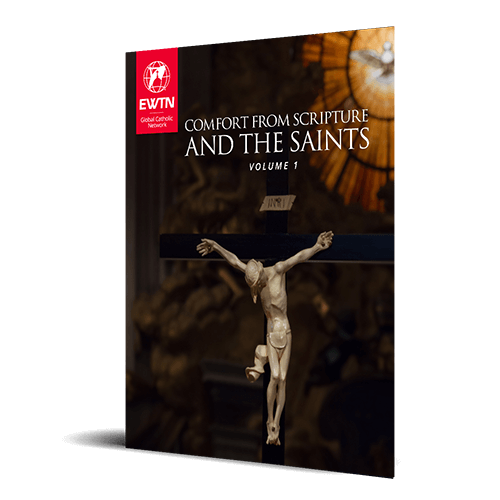
This eBook combines stunning photography from EWTN’s Vatican Bureau along with Bible passages and saints’ quotes that will calm your heart, give you hope, and remind you that God is with us always. Simply fill out the form below and we will send this to you!
Be inspired to follow in the footsteps of the saints. Subscribe to receive the Daily Saint, featuring a brief biography delivered to your inbox each day.
Start now and let the intercession and witness of the saints draw you closer to God.

As we deepen our relationship with the Eternal Word, Jesus Christ, we grow in grace and are transformed by His love and mercy.
STEP 1
We’re here to serve you. Let us help you complete your gift with confidence.

Send a message to Mission Advancement.

Guidance for DAFs, stock, IRA, and more.

Manage your gifts and preferences.