

Your Faith Journey with EWTN
As we deepen our relationship with the Eternal Word, Jesus Christ, we grow in grace and are transformed by His love and mercy.
4th century–360 A.D.
Patron Saint of epilepsy, headaches, insanity, mental illness, torture victims, parishes, and single lay women

St. Bibiana and her sister were born into a Roman noble family and raised in the Christian faith. Her parents were Christians and faced persecution from the Roman Governor Apronianus.
After her father was severely scourged and exiled, he died of his wounds, leaving St. Bibiana and her mother and sister impoverished. Her mother and her sister, Demetria, died a natural death, leaving St. Bibiana alone.
The Governor Apronianus pressured St. Bibiana to abandon their faith, but she refused to deny Christ. A pagan woman attempted to force her into corrupt acts, yet she remained faithful. She was then tied to a column and whipped with leaded scourges. She died from the intense torture she sustained.
According to tradition, after her death, her executioners left her remains exposed to be torn apart by the wild beasts, but the animals refused to defile them. Two days later, a priest buried her remains.
Her body is entombed in what became the Basilica of Santa Bibiana in Rome. Pope Simplicius consecrated the church in the late 5th century.
The Basilica of Santa Bibiana sits on the Esquiline Hill in Rome. In the fifth century, Pope Simplicius consecrated the church over St. Bibiana’s tomb. In the 17th century, the church was reconstructed with a facade designed by Gian Lorenzo Bernini, an Italian sculptor and architect known for his Baroque style. St. Bibiana’s relics, as well as those of her mother and sister, are kept in the church.
Her patronage reflects the traditions and devotions that grew around her over centuries. Because of her own sufferings, especially the tortures and mental anguish, she came to be invoked by those with seizures, mental illness, and headaches.
St. Bibiana is represented in art in various ways. Sometimes, she is shown tied to a column or holding a scourge. Other images show her holding a palm branch to symbolize her martyrdom. The famous sculpture of St. Bibiana, created by Bernini in the 17th century, portrays her beside a column, looking up with an anguished, yet hopeful expression. The image effectively communicates the suffering she endured, the courage she demonstrated, and the trust she had in her Divine Savior.
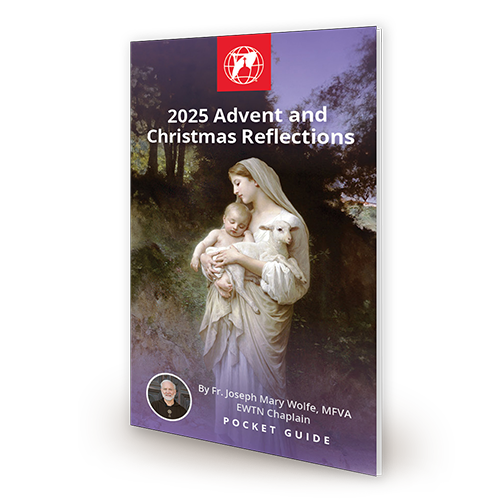
Sign up below for the free 2025 Advent and Christmas Reflections pocket guide, featuring meditations by Fr. Joseph Mary Wolfe, the EWTN Chaplain. His video series will also be sent to your email each Sunday of Advent and throughout the Christmas season. When you request the pocket guide by mail, we’ll also email you the eBook version. Or you may choose to receive just the eBook version and video series.
Send me the Physical Pocket Guide
Only available to homes in the U.S.A., while supplies last.
Send me the eBook
Be inspired to follow in the footsteps of the saints. Subscribe to receive the Daily Saint, featuring a brief biography delivered to your inbox each day.
Start now and let the intercession and witness of the saints draw you closer to God.

As we deepen our relationship with the Eternal Word, Jesus Christ, we grow in grace and are transformed by His love and mercy.
STEP 1
We’re here to serve you. Let us help you complete your gift with confidence.

Send a message to Mission Advancement.

Guidance for DAFs, stock, IRA, and more.

Manage your gifts and preferences.