

Your Faith Journey with EWTN
As we deepen our relationship with the Eternal Word, Jesus Christ, we grow in grace and are transformed by His love and mercy.
October 3, 1458–March 4, 1484
Patron Saint of Lithuania, Poland, youth, princes, peacemakers, those seeking purity of heart

St. Casimir was a royal prince whose brief life exemplified holiness, humility, and devotion. Born in 1458, he was the second son of King Casimir IV of Poland and Queen Elizabeth of Austria. St. Casimir was formed in the Catholic Faith and demonstrated exceptional piety from an early age.
St. Casimir showed great devotion to the Faith. Despite his privileged life, he practiced spiritual disciplines, including fasting, mortification, and long hours in prayer and adoration. He was also devoted to the Blessed Virgin Mary and sang hymns in her honor.
His integrity and sense of moral responsibility distinguished him in a political world often marked by ambition and challenges. At age 15, his father wanted to install him as King of Hungary, and, in obedience, St. Casimir led an army into battle, which failed. St. Casimir faced larger numbers of opposing forces than expected, and the troops’ food stores diminished. Many of St. Casmir’s men fell ill, and others deserted. After retreating, he was advised by his father to get married and build political alliances.
Despite royal expectations, St. Casimir firmly rejected marriage, choosing instead to consecrate his life to God through a vow of chastity. Over time, his health deteriorated, and he eventually contracted tuberculosis.
He died peacefully on March 4, 1484, at the age of 25. Venerated almost immediately after his death, St. Casimir became a beloved patron of Lithuania and Poland. Numerous miracles were attributed to St. Casimir after his death. He was canonized in 1602.
St. Casimir is honored in Lithuania as its patron saint and a model of faith because he was a pious prince, the son of King Casimir IV and Elizabeth of Austria, linking him directly to the Lithuanian-Polish ruling house and making him “one of their own.”
He embodied virtues like purity and justice that resonated deeply with the Lithuanian people, especially its youth. He became a symbol of national identity and spiritual strength. St. Casimir was credited with a miracle of intercession that helped the Lithuanian army win a battle, making him the country’s protector and patron saint. His relics are enshrined in Vilnius Cathedral, which became an important pilgrimage site and center of national devotion.
Numerous miracles were attributed to St. Casimir after his death. A young girl named Ursula was miraculously brought back to life after her father prayed at St. Casimir’s tomb. There were reports of sick people being cured and blind people regaining their sight after venerating his body. St. Casimir reportedly appeared in a vision to the Lithuanian army, showing them a safe path across the Daugava River to defeat invading Russian forces, making him a patron of Lithuania and Poland. More than a century after his death, his body was found incorrupt, emitting a sweet fragrance, and still holding a hymn to the Virgin Mary.
In sacred art, St. Casimir is often depicted as a young prince dressed in royal robes, holding a lily as a symbol of purity and chastity. He may also be shown with a cross or a scroll bearing Marian hymns. Lithuanian iconography sometimes portrays him with three hands—an unusual symbol derived from a legend where a painted hand kept reappearing after being painted over multiple times. Various interpretations of his piety, purity, and generosity have been offered to explain the reappearance of the third hand.
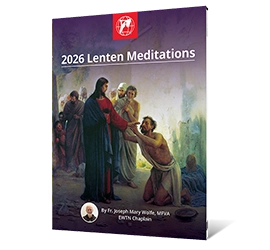
Prepare your soul for the glorious Resurrection with free weekly prayers and reflections from EWTN Chaplain Fr. Joseph Mary Wolfe, MFVA—exploring the healing power of Christ’s love. You’ll also receive weekly emails from Fr. Joseph beginning on Ash Wednesday, continuing each Sunday of Lent and Easter Sunday.
Draw closer to Our Lord as you pause, meditate, and return to Him with your whole heart.
Send me the Physical Pocket Guide
Only available to homes in the U.S.A.
Send me the
eBook
Be inspired to follow in the footsteps of the saints. Subscribe to receive the Daily Saint, featuring a brief biography delivered to your inbox each day.
Start now and let the intercession and witness of the saints draw you closer to God.

As we deepen our relationship with the Eternal Word, Jesus Christ, we grow in grace and are transformed by His love and mercy.
STEP 1
We’re here to serve you. Let us help you complete your gift with confidence.

Send a message to Mission Advancement.

Guidance for DAFs, stock, IRA, and more.

Manage your gifts and preferences.