

Your Faith Journey with EWTN
As we deepen our relationship with the Eternal Word, Jesus Christ, we grow in grace and are transformed by His love and mercy.
c. early third century–c. 260 A.D.
Patron Saint of Nola, Italy; lost domestic animals; against perjury; and eye trouble

St. Felix of Nola was a third-century priest revered for his humility, courage, and miraculous protection during Roman persecution. Born in Nola, near Naples, Italy, St. Felix was the son of Hermias, a retired Syrian centurion. After his father’s death, St. Felix gave away most of his inheritance to the poor and chose the path of religious life. He was ordained a priest and served under Bishop Maximus of Nola.
During the persecution of Emperor Decius around 250 A.D., Bishop Maximus fled into hiding. When the Roman soldiers couldn’t find the bishop, they arrested St. Felix and tortured him for his Christian faith. According to tradition, an angel freed St. Felix from prison and led him to the bishop, who was sick and starving. Felix carried Bishop Maximus to safety and hid him in a vacant building. Miraculously, spiders spun a web across the entrance, deceiving the Roman soldiers into thinking the building was abandoned.
The Romans continued to pursue St. Felix and the bishop, but they evaded capture. Though he is often referred to as a martyr, historical records suggest he survived his tortures and died peacefully around 260 A.D. He was buried in Cimitile, near Naples, Italy. His tomb in Nola became a site of pilgrimage.
St. Paulinus of Nola later wrote poems honoring St. Felix and attributed to him miracles of divine protection during his own time. St. Felix was widely venerated in the early Church for his heroic virtue, demonstrated by his willingness to risk his life and suffer torture at the hands of Roman soldiers to protect Bishop Maximus.
After his burial near Nola, St. Felix’s tomb quickly became famous for reported miracles, which drew pilgrims from across the region. Although he died of natural causes, Felix was venerated as a martyr because he was imprisoned, was tortured, and suffered for his faith during the persecution of Emperor Decius. Other saints, such as St. Paulinus, Pope St. Damasus, and St. Augustine of Hippo, later wrote in honor of St. Felix, and his story became better known. A monastic community and a basilica dedicated to him were built at Cimitile, the site of his original burial. The Cathedral of Nola in Italy was also built and dedicated to him. His relics are currently preserved in this cathedral. A liquid substance, known as the “Manna of St. Felix,” is said to exude from his tomb in the crypt of the Cathedral in Nola.
The story of St. Felix’s life is known primarily through the poetry of St. Paulinus, who became bishop of Nola about a century after St. Felix died. St. Paulinus describes St. Felix’s generosity in giving to the poor the inheritance he received when his father died. He wrote about St. Felix’s servant heart, saying that as a priest, St. Felix served faithfully under Bishop Maximus of Nola and was dedicated to caring for the poor in the diocese. During the Decius persecution in the third century, St. Felix risked his own life, undergoing arrest and torture to help his sick and starving bishop, who was in hiding. Always humble, St. Felix declined the offer to become the next bishop of Nola, allowing a priest who had been ordained before him to take the position. During the persecutions, the Roman government confiscated St. Felix’s property. He lived a life of humble poverty, renting a small plot of land to farm and giving most of his earnings to those who were in greater need.
A century after St. Felix’s death, St. Paulinus of Nola, a devotee of St. Felix, wanted to honor the saint’s life. In 396, he presented the first of 14 poems on St. Felix’s feast day. St. Paulinus’s poems describe St. Felix’s life, the miracles attributed to him, and his power over animals. He also documents the construction of a shrine to St. Felix and the ceremonies and celebrations held there. These writings helped spread St. Felix’s story more widely.
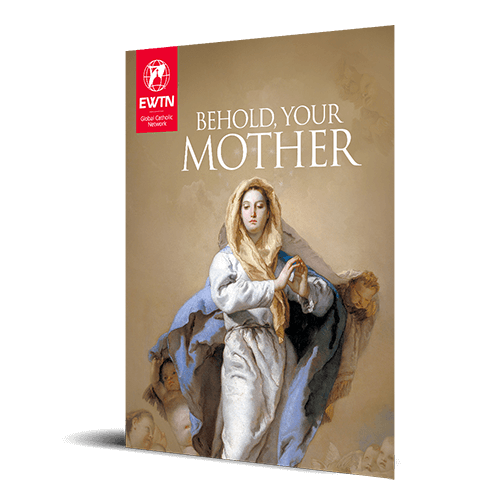
We hope this special eBook will draw you closer to our Blessed Mother and her Son, Jesus Christ. We trust that the pages will bring your heart under her mantle, as we share a few of the beautiful and befitting names bestowed upon the Blessed Virgin Mary.
Be inspired to follow in the footsteps of the saints. Subscribe to receive the Daily Saint, featuring a brief biography delivered to your inbox each day.
Start now and let the intercession and witness of the saints draw you closer to God.

As we deepen our relationship with the Eternal Word, Jesus Christ, we grow in grace and are transformed by His love and mercy.
STEP 1
We’re here to serve you. Let us help you complete your gift with confidence.

Send a message to Mission Advancement.

Guidance for DAFs, stock, IRA, and more.

Manage your gifts and preferences.