

Your Faith Journey with EWTN
As we deepen our relationship with the Eternal Word, Jesus Christ, we grow in grace and are transformed by His love and mercy.
1577–April 24, 1622
Patron Saint of lawyers, missionaries, those facing persecution for the Faith

St. Fidelis of Sigmaringen is remembered as a priest and martyr whose conversion of heart led him from a successful legal career to a life totally dedicated to Christ. Born Mark Rey in 1578 in Sigmaringen, Germany, he received an excellent education in philosophy and law. As a young lawyer, he quickly became known for his integrity and compassion, earning a reputation as a defender of the poor and vulnerable.
Despite professional success, he felt a call to serve God. He left his legal career and entered the Capuchin Franciscan Order, taking the religious name Fidelis, meaning “faithful,” at his priestly ordination.
During the early 17th century, religious tensions ran high in parts of Europe. St. Fidelis was sent as a missionary to the Grisons region of Switzerland, where Catholic communities faced hostility and division as Calvinist Protestantism spread. Fully aware of the dangers, he accepted the mission out of obedience, love for souls, and a deep desire to proclaim the Truth of the Faith.
On April 24, 1622, St. Fidelis was returning from preaching when he was attacked by a mob of Calvinists who demanded he renounce his Catholic Faith or die. It is said he responded, “The Catholic religion is the faith of all ages. I fear not death.”
He was stabbed to death. According to accounts, his final words expressed forgiveness for his persecutors and steadfast trust in God. His resolute faith led one of his murderers to later convert to Catholicism.
St. Fidelis was canonized in 1746 by Pope Benedict XIV. Several miracles were attributed to him after his death.
St. Fidelis of Sigmaringen, originally named Mark Rey, was often called “The Poor Man’s Lawyer.” He left his successful legal career due to intense disillusionment with the rampant corruption in his chosen field. He chose the legal profession to bring justice to the oppressed, but he found instead unethical practices, dishonesty, and greed prevalent among his colleagues. He was disgusted by the lengths to which other lawyers would go to win cases. Rather than fighting a corrupt system, he chose to serve God. He entered the Capuchin Order, where he devoted his life to serving the poor and, eventually, to preaching the Gospel and proclaiming the Apostolic Catholic Faith during the Counter-Reformation.
St. Fidelis successfully converted numerous Swiss Calvinists to Catholicism during the Counter-Reformation by combining zealous preaching, theological expertise, and dedicated charity for the poor and sick. He actively preached in public, conducted debates, and wrote pamphlets defending Catholic doctrine against Calvinism and Zwinglianism. His intellectual defense of the Faith led to the conversion of many, including influential individuals such as Rodolph de Salis, a leader in Zürich, Switzerland. Rodolph was considered the most influential man in the town, and his conversion by the Capuchin friar in 1622 was a notable success that led many others to return to the Catholic Faith. His charitable works and care for sick soldiers during epidemics, as well as his life of austerity, prayer, and devotion to the Eucharist, earned respect and supported his arguments. His death at the hands of Calvinists in 1622 solidified his reputation, with one of the ministers involved in his murder converting shortly after.
During a severe plague epidemic in Austria or Switzerland in the early 1620s, St. Fidelis was a fearless caregiver to sick soldiers, providing “humble” care, serving as a nurse during a petechia epidemic. He also attended to their spiritual needs and provided pastoral care. As guardian of a Capuchin friary, he continuously attended to infected troops, often risking contagion, and was credited with healing many afflicted by the disease. He used the Capuchin friary he was guarding to house and treat the sick, with a particular focus on soldiers. As a follower of St. Francis of Assisi, he disregarded the high risk of infection, seeing it as his duty to care for the ”weak and needy.” His actions during this time were a testament to his dedication to serving the suffering, and he was revered for his charitable deeds.
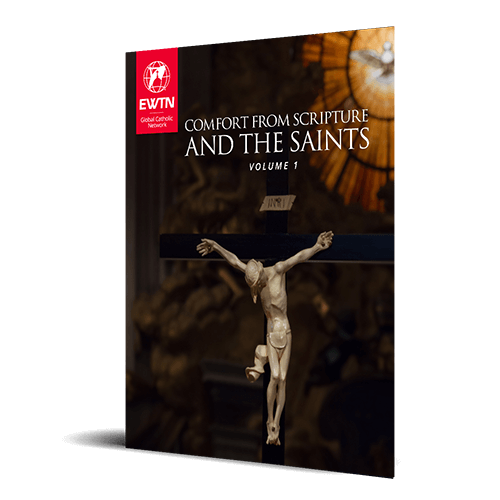
This eBook combines stunning photography from EWTN’s Vatican Bureau along with Bible passages and saints’ quotes that will calm your heart, give you hope, and remind you that God is with us always. Simply fill out the form below and we will send this to you!
Be inspired to follow in the footsteps of the saints. Subscribe to receive the Daily Saint, featuring a brief biography delivered to your inbox each day.
Start now and let the intercession and witness of the saints draw you closer to God.

As we deepen our relationship with the Eternal Word, Jesus Christ, we grow in grace and are transformed by His love and mercy.
STEP 1
We’re here to serve you. Let us help you complete your gift with confidence.

Send a message to Mission Advancement.

Guidance for DAFs, stock, IRA, and more.

Manage your gifts and preferences.