

Your Faith Journey with EWTN
As we deepen our relationship with the Eternal Word, Jesus Christ, we grow in grace and are transformed by His love and mercy.
c. 1096–April 18, 1176
Patron Saint of the Archdiocese of Milan, Lombardy

St. Galdinus of Milan was a devoted bishop and cardinal whose life bore witness to fidelity and courage during a turbulent period in the Church. Born in Milan around 1096, he was educated in theology and canon law and ordained a priest, quickly gaining recognition for his knowledge and pastoral zeal.
He served as archdeacon, chancellor, and advisor to Archbishop Hubert of Milan. In 1159, a schism occurred that led to a fierce political and religious conflict between the papacy and Emperor Frederick Barbarossa, who supported rival claimants to certain bishoprics and to the Chair of Peter. St. Galdinus became a trusted ally of Pope Alexander III, defending him against several antipopes. The emperor declared war against Italy, capturing Rome and forcing Pope Alexander III to flee.
Refusing to pledge his loyalty to an antipope, St. Galdinus was also forced into exile. During this time, he met with Pope Alexander III. He traveled extensively with him, preaching against schism and heresy while strengthening Catholic communities throughout northern Italy and in parts of France. Returning to Milan after the war and years of hardship, he resumed his pastoral duties and devoted himself to preaching, catechesis, and pastoral care of his flock. The pope appointed him as Archbishop of Milan in 1165 and elevated him to the office of cardinal a year later.
According to tradition, St. Galdinus died suddenly on April 18, 1176, collapsing while preaching against heresy in Milan. His death was seen by the faithful as the final testimony of a life poured out in defense of the Church. During his pontificate, Pope Alexander II canonized him.
St. Galdinus served under Archbishop Huber of Milan and was a close ally of his. Both men supported the legitimate Pope Alexander III during a papal schism. Emperor Frederick Barbarossa favored antipope Victor IV. When the emperor launched a military campaign to attack and sack Milan, Archbishop Hubert and St. Galdinus were forced to flee for their safety. Both men were staunch supporters of Pope Alexander III, the legitimate pope, and had taken a very public stance in his favor. This put them in direct opposition to the emperor. While in exile, St. Galdinus followed Pope Alexander III on his various travels, including stays in Maguelonne, Montpellier, and Clermont in France, as well as in parts of Sicily and Rome in Italy, working to secure recognition of Pope Alexander’s legitimacy from European monarchs. During exile, they built support for the Church, maintained administrative control, and rallied the Lombard League against imperial forces. After the war, St. Galdinus returned to Milan, where the pope named him cardinal and appointed him Archbishop of Milan in 1166.
The twelfth-century schism was primarily caused by a power struggle over imperial control in Italy. The Emperor Frederick Barbarossa wanted to assert absolute sovereignty over the papacy, defying the Gregorian Reform. Following Pope Adrian IV’s death, a majority of cardinals elected Alexander III, while a minority, supported by the imperial faction, chose the antipope Victor IV. This resulted in a papal schism. The emperor wanted control over the papacy to assert imperial rights over northern Italian cities and the Church, challenging the pope’s authority. He convened a council that recognized the antipope, but the legitimate pope refused to submit, supported by most of Western Europe, except Germany, causing a sustained schism that lasted until 1177.
Emperor Frederick Barbarossa initiated a sustained, declared military campaign to crush Italian independence and impose an imperial antipope following a disputed papal election. The emperor supported a series of antipopes against Pope Alexander III, who was supported by the Italian cities, France, and England. Open conflict escalated when Emperor Barbarossa attempted to impose imperial taxes and direct control over Northern Italian cities. Milan rebelled and was destroyed by imperial forces in 1162. In response to his aggression and support of antipopes, several northern Italian cities formed the Lombard League, which allied Pope Alexander III against the emperor. The emperor invaded Italy in 1167, captured Rome, and installed his antipope (Paschal III), forcing Pope Alexander III to flee. The culmination of this war was the Battle of Legnano in 1176, where the Lombard League defeated Barbarossa’s imperial army. The conflict ended with the Peace of Venice in 1177, where Barbarossa recognized Alexander III as the true pope and later granted the Lombard cities the right to self-governance.
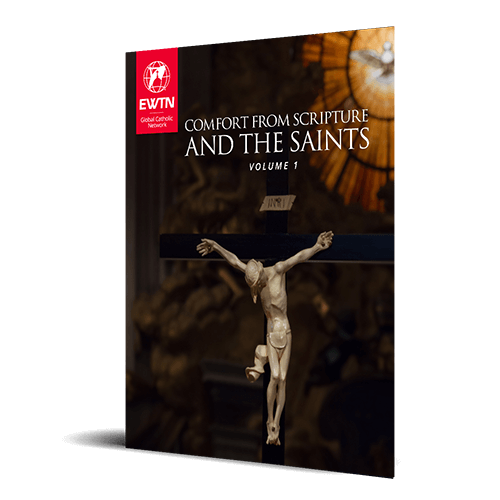
This eBook combines stunning photography from EWTN’s Vatican Bureau along with Bible passages and saints’ quotes that will calm your heart, give you hope, and remind you that God is with us always. Simply fill out the form below and we will send this to you!
Be inspired to follow in the footsteps of the saints. Subscribe to receive the Daily Saint, featuring a brief biography delivered to your inbox each day.
Start now and let the intercession and witness of the saints draw you closer to God.

As we deepen our relationship with the Eternal Word, Jesus Christ, we grow in grace and are transformed by His love and mercy.
STEP 1
We’re here to serve you. Let us help you complete your gift with confidence.

Send a message to Mission Advancement.

Guidance for DAFs, stock, IRA, and more.

Manage your gifts and preferences.