

Your Faith Journey with EWTN
As we deepen our relationship with the Eternal Word, Jesus Christ, we grow in grace and are transformed by His love and mercy.
c. late third century–c. April 23, 303
Patron Saint of soldiers, knights, scouts, England

St. George is among the most universally venerated martyrs in Christian history, honored for his courage, fidelity, and readiness to give his life for Christ. Born in Cappadocia to Christian parents in the late third century, he moved with his mother to Palestine after his father’s death. There, his faith was nurtured and strengthened.
As a young man, he followed in his father’s footsteps and joined the Roman army. He soon distinguished himself as an exceptional soldier. Serving under Emperor Diocletian, he rose to a position of authority. When Diocletian initiated one of the fiercest persecutions of Christians, St. George faced a defining choice. Rather than conceal his faith, he boldly professed his belief in Christ and condemned the emperor’s actions.
His refusal to renounce Christianity led to imprisonment and brutal torture. Despite intense suffering, he remained resolute in the Faith. According to early accounts, his endurance converted many soldiers and other pagans to Christianity. According to early accounts, he converted the emperor’s wife, Empress Alexandra, who was also martyred.
St. George endured long, brutal tortures and was beheaded around the year 303, earning the crown of martyrdom. Devotion to him spread rapidly throughout the Eastern and Western Churches, and by the Middle Ages, he had become a symbol of Christian courage and chivalry.
One of the most enduring images associated with St. George is the legendary account of him slaying a dragon to save a town and its people. While symbolic rather than historical, this image represents the triumph of good over evil and the power of faith to overcome fear and oppression.
St. George’s heroic virtue is honored in churches and shrines across the world that bear his name. He is the patron saint of England and numerous other countries and cities worldwide.
According to tradition, multiple accounts of St. George record miraculous interventions during the tortures he endured. Witnesses were convinced of the Truth of the Faith by the saint’s unwavering courage, miracles performed during his torture, and his courage in facing death. Accounts describe him surviving and often being immediately healed following severe torture through divine intervention. After being thrown into a pit of quicklime for three days, intended to destroy his body, he was found alive and unharmed by the power of God. Another account tells of a magician named Athanasius who gave him a cup of deadly poison, but after he made the Sign of the Cross over it, he drank it and remained unharmed, leading to the magician’s conversion. The accounts cite two high-ranking Roman officials, Anatolius and Protoleon, and the emperor’s wife, who were also among those converted after witnessing the miracles. After his death, numerous miracles were reported at his grave.
Empress Alexandra of Rome was believed to be the wife of the Roman Emperor Diocletian, a known persecutor of Christians during the late third and early fourth centuries. She is a Christian martyr who, according to tradition, became convinced of the truth of Christianity and converted to Christianity after witnessing the steadfast faith and miracles of St. George during his torture. Legend states that when she worried about dying before being baptized, St. George told her, “Do not fear, for your blood will baptize you.” She publicly professed her faith and was executed around 303 or 314 A.D. She is venerated as a saint in the Orthodox Church, with her feast day celebrated on April 21 or May 6.
St. George embodies the ideal medieval Christian soldier: virtuous, courageous, and protective. Historically, he was a fourth-century Roman martyr depicted in iconography as a horseman. His legend, particularly slaying a dragon to save a princess, mirrored the ideal of a noble knight rescuing a damsel in distress, making him a symbol of chivalry. During the Crusades, soldiers believed they saw St. George leading them in battle, which led to him becoming a patron saint of soldiers and knights. King Richard the Lionheart is believed to have adopted St. George’s banner during his campaigns, further linking the saint to English knighthood, and various orders of knighthood, such as the Order of St. George, founded in 1326, were established in his honor.
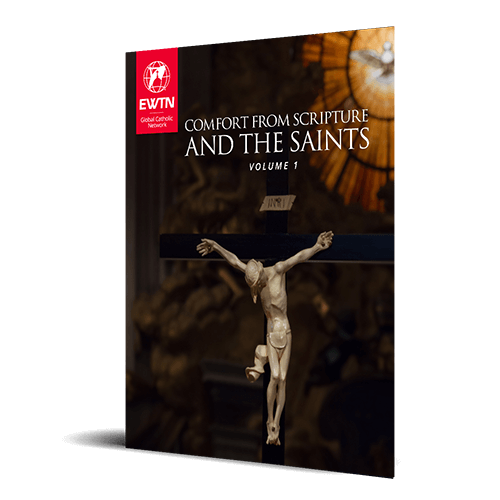
This eBook combines stunning photography from EWTN’s Vatican Bureau along with Bible passages and saints’ quotes that will calm your heart, give you hope, and remind you that God is with us always. Simply fill out the form below and we will send this to you!
Be inspired to follow in the footsteps of the saints. Subscribe to receive the Daily Saint, featuring a brief biography delivered to your inbox each day.
Start now and let the intercession and witness of the saints draw you closer to God.

As we deepen our relationship with the Eternal Word, Jesus Christ, we grow in grace and are transformed by His love and mercy.
STEP 1
We’re here to serve you. Let us help you complete your gift with confidence.

Send a message to Mission Advancement.

Guidance for DAFs, stock, IRA, and more.

Manage your gifts and preferences.