

Your Faith Journey with EWTN
As we deepen our relationship with the Eternal Word, Jesus Christ, we grow in grace and are transformed by His love and mercy.
Fourth century–500 or 523
Patron Saint of widows, abused women, and those suffering domestic hardship

St. Gladys was a Welsh queen and the daughter of the Irish king, St. Brychan of Brecknock. She was raised in a Royal and Christian court and was known for her beauty.
While intertwined with legend, her story is one of transformation that began with a violent abduction and culminated years later in St. Gladys and her abductor devoting their lives to God as hermits.
King Gwynllyw, a rough pagan warrior-king, saw the beautiful St. Gladys and sent word to her father asking for her hand in marriage. Perceiving that the suitor was not worthy of his daughter, King Brychan rejected the offer. Determined to have St. Gladys, the warrior king, with three hundred men, attacked King Brychan’s kingdom and abducted St. Gladys. A war broke out between the two kingdoms, but eventually, the incident was resolved, and St. Gladys and King Gwynllyw were married.
St. Gladys had a difficult life, as her husband was a merciless warrior who attacked and raided other kingdoms. The couple had seven children together, whom St. Gladys raised as Christians. All her children became saints. Her eldest son, St. Cadoc, was a missionary and founder of a monastery. He and St. Gladys convinced the king to amend his ways and become a Christian. King Gwynllyw eventually decided to abandon his violent ways.
After raising their children, St. Gladys and her husband followed a vision revealed to the king, which called him to live a life of prayer and penance. They separated to remain celibate and draw closer to God.
After the death of her husband, St. Gladys founded a hermitage at Pencarn near Bassaleg, where she lived as a hermitess in her last years. She died in 523 and is buried in Gelligaer, Wales. A Celtic cross slab marks her tomb.
Devotion to St. Gladys developed in Wales because of her powerful personal story and the conversion of her husband, King Gwynllyw. Her legacy was further established by her status as the mother of several saints, most notably her son, St. Cadoc, a highly influential figure. St. Gladys’s journey from an abducted princess to a pious monarch and eventually a solitary hermitess offered a powerful narrative of transformation and a model of a devoted spouse and parent leading her family to a holy life. Her story made her a widely relatable and inspiring figure. Much of her story comes from medieval hagiographies, such as the Life of St. Cadoc. These texts interweave historical details with legendary stories of drama and compelling narratives that helped spread St. Gladys’s story and promote her veneration among the Welsh people.
St. Gladys, Queen of Wales, founded hermitages in South Wales, notably at Pencarn, Bassaleg, and Gelligaer. She influenced women’s monasticism, primarily through her example as an early Welsh hermitess and her role in transitioning from a royal life to one of asceticism. She is noted for living a life of penance, which included fasting and, according to tradition, bathing in cold water. Later in life, she moved to Gelligaer, where she lived as a hermitess. While St. Gladys did not establish a large monastic order, she is an early example of a consecrated woman in that region. She is revered as a sixth-century Welsh saint who embraced a life of prayer and solitude.
St. Gladys’s children were her legacy; all her children became saints. The best known is St. Cadoc, a pivotal sixth-century Welsh saint who founded the famous Llancarfan monastery in South Wales. He became a key figure in Celtic monasticism, establishing numerous churches across Wales, Cornwall, and Brittany and serving as a renowned teacher. St. Cadoc refused a royal throne to dedicate his life to God. As a respected abbot and pioneer of Welsh monasticism, he helped spread Christianity by founding churches in Wales, France, and Scotland. He was known as “Cadoc the Wise” for his moral sayings and deep learning, including a love for classical texts.
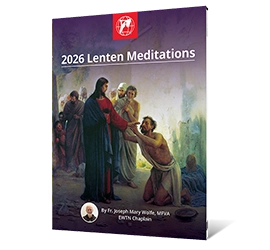
Prepare your soul for the glorious Resurrection with free weekly prayers and reflections from EWTN Chaplain Fr. Joseph Mary Wolfe, MFVA—exploring the healing power of Christ’s love. You’ll also receive weekly emails from Fr. Joseph beginning on Ash Wednesday, continuing each Sunday of Lent and Easter Sunday.
Draw closer to Our Lord as you pause, meditate, and return to Him with your whole heart.
Send me the Physical Pocket Guide
Only available to homes in the U.S.A.
Send me the
eBook
Be inspired to follow in the footsteps of the saints. Subscribe to receive the Daily Saint, featuring a brief biography delivered to your inbox each day.
Start now and let the intercession and witness of the saints draw you closer to God.

As we deepen our relationship with the Eternal Word, Jesus Christ, we grow in grace and are transformed by His love and mercy.
STEP 1
We’re here to serve you. Let us help you complete your gift with confidence.

Send a message to Mission Advancement.

Guidance for DAFs, stock, IRA, and more.

Manage your gifts and preferences.