

Your Faith Journey with EWTN
As we deepen our relationship with the Eternal Word, Jesus Christ, we grow in grace and are transformed by His love and mercy.
c.310–c. 367

St. Hilary of Poitiers (c. 310–367) was a bishop, theologian, and one of the earliest Doctors of the Church. Born in Poitiers, Gaul (modern-day France), into a noble pagan family, St. Hilary received a classical education and was deeply influenced by various philosophies. His study of Scripture—especially the Gospel of John—led him to convert to Christianity and to receive Baptism around 345 A.D.
St. Hilary’s spiritual and intellectual gifts led to his election as Bishop of Poitiers in 353 A.D. During this time, Arianism, a heresy that denied Christ’s full divinity, was spreading. St. Hilary became one of the strongest defenders of Trinitarian orthodoxy in the Western Church, earning the title “Hammer of the Arians.”
His opposition to Arianism caused the Emperor Constantius II to exile him to Phrygia (modern-day Türkiye). In exile, St. Hilary continued writing theological works, including his most famous treatise, De Trinitate (On the Trinity), a twelve-volume collection that conveyed the mystery of the Trinity with clarity and depth. He also composed hymns and commentaries on the Psalms and the Gospel of Matthew. And he continued to advocate for the condemnation of Arianism.
After the death of Emperor Constantius II, St. Hilary returned to Poitiers, where he resumed his pastoral duties and continued teaching and writing, which extended his efforts against the Arian heresy beyond his diocese.
St. Hilary died around 367 and was recognized as a Doctor of the Church by Pope Pius IX in 1851. His fortitude, fidelity, and deep love for truth inspire and exemplify a life of Christian virtue.
Emperor Constantius II exiled him in 356 A.D. for resisting Arianism and defending orthodox doctrine. St. Hilary’s exile lasted for about four years, from 356 to 360. To avoid being exiled, he was told to condemn Athanasius, the Patriarch of Alexandria, for defending the orthodox Nicene faith against Arianism. St. Hilary refused to do so. He was exiled to Phrygia, an area in modern-day Türkiye. Emperor Constantius II eventually allowed him to return to Gaul (modern-day France).
St. Hilary wrote his most important work, De Trinitate (On the Trinity), which refuted Arianism. He also composed De Synodis, a text for Western bishops that explained the history of the Arian controversy and urged them to defend Nicene orthodoxy. Throughout his exile, St. Hilary never stopped making his opposition against Arianism known. He urgently and often requested public debates with his opponents, and he attended synods on Arianism during his exile. He traveled to Constantinople to explain to the city’s bishops why their emperor was not orthodox. St. Hilary consistently worked to restore the unity of the Church based on the true Faith as defined by the Council of Nicaea. St. Hilary’s constant petitions to the emperor became so disruptive to the Arians that they asked the emperor to send him back to his diocese.
After leaving the army, St. Martin of Tours went to Poitiers to meet St. Hilary. He admired St. Hilary’s reputation as a devout bishop and his strong opposition to the Arian heresy. St. Hilary, impressed by St. Martin, took him on as his student. St. Hilary provided St. Martin with a place to live and study. He ordained St. Martin as a deacon and later ordained him to the priesthood, supporting his desire to live a monastic life by giving him land in Ligugé to build a monastery. It was the first monastery in Gaul. St. Martin’s original monastery was destroyed during the French Revolution. In 1853, the Benedictines rebuilt the Abbey of Saint-Martin de Ligugé, and it is still active today.
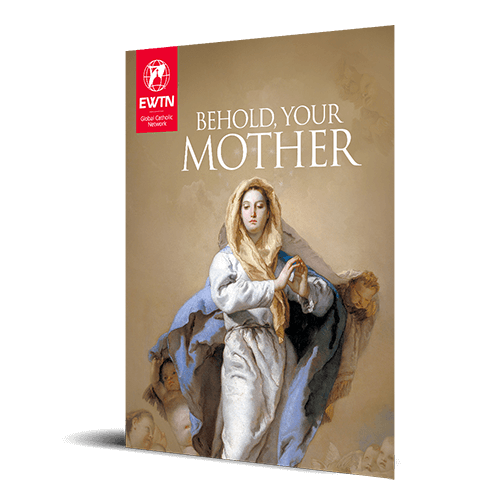
We hope this special eBook will draw you closer to our Blessed Mother and her Son, Jesus Christ. We trust that the pages will bring your heart under her mantle, as we share a few of the beautiful and befitting names bestowed upon the Blessed Virgin Mary.
Be inspired to follow in the footsteps of the saints. Subscribe to receive the Daily Saint, featuring a brief biography delivered to your inbox each day.
Start now and let the intercession and witness of the saints draw you closer to God.

As we deepen our relationship with the Eternal Word, Jesus Christ, we grow in grace and are transformed by His love and mercy.
STEP 1
We’re here to serve you. Let us help you complete your gift with confidence.

Send a message to Mission Advancement.

Guidance for DAFs, stock, IRA, and more.

Manage your gifts and preferences.