

Your Faith Journey with EWTN
As we deepen our relationship with the Eternal Word, Jesus Christ, we grow in grace and are transformed by His love and mercy.
7th century–c. 720
Patron Saint of Trier, Germany, and the Diocese of Trier, Germany

St. Irma (also called Irmina) was a Benedictine abbess of royal lineage living in the eighth century. She is recognized for her leadership, generosity, and support of missionary activity in the Frankish lands.
According to tradition, she was a daughter of King Dagobert II of Austrasia and his queen Matilda. Her upbringing in a royal household placed her among the elite of her time. Her father arranged a marriage for her to Count Hermann. However, Count Hermann died in a murder-suicide plot before they could marry.
Following the premature death of her betrothed, Irma decided to enter religious life, and her father supported her decision. She founded and became the abbess of the convent at Oeren, a property given to her by her noble family.
St. Irma is known for her support of the missionary work of St. Willibrord, the English missionary monk active in Frisia. She donated the land at Echternach to Willibrord to establish a monastery there around 697-698, making her a co-founder of the monastery. Her generosity extended to both Celtic and Saxon missionary monks, as Irma helped sustain their work both spiritually and materially.
In later years, she governed her community according to Benedictine principles, which included prayer, hospitality, care for the poor, and a simple lifestyle. She died around 716 at the monastery at Weissenburg, leaving a strong spiritual legacy and patronage in the Diocese of Trier and among communities connected to St. Willibrord’s mission.
The land donation to St. Willibrord’s missionary endeavor—especially for Echternach—was critical. It enabled the foundation of a major monastery that played a vital role in the Christianization of Frisia and parts of what are now the Netherlands and Germany. Such monasteries were centers of evangelization, preaching, education, and culture; Irma’s gift helped the Church grow beyond her local region.
St. Irma’s sister, St. Modesta, served as the first abbess of the convent in Oeren. Later, St. Irma became the second abbess of the convent. Their family had donated the land for the construction of the monastery. The abbey was later named St. Irminen Abby, in honor of St. Irma.
Saints’ relics are often moved to various locations over the centuries. No information is available on St. Irma’s remains. St. Irma is fondly remembered in the communities she served. In depictions of St. Irma, she is portrayed holding a model of a church in her hand, indicating her contribution to building up the Church in her region. Angels are often depicted above her head, carrying her soul to Heaven. A statue of St. Irma is displayed at the Abbey of Echternach.
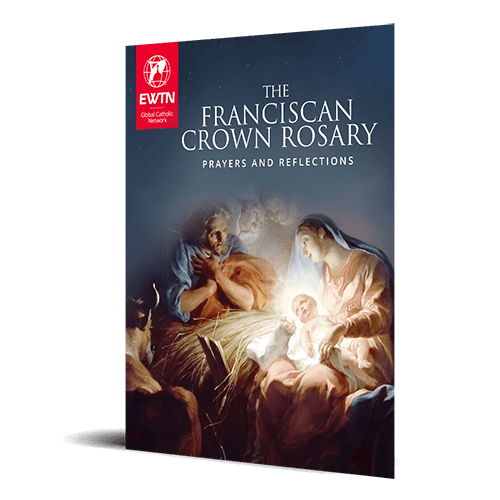
One unique devotion of the Franciscans is a seven-decade rosary known as the Franciscan Crown. While the traditional rosary consists of 5 decades which meditate on 15 mysteries, the 7-decade Franciscan Rosary, known as the Franciscan Crown, is a Rosary consisting of seven decades with each decade describing a particular joy from the life of the Blessed Virgin Mary. We hope that this special resource will help you meditate on each of the Seven Joys of Our Blessed Mother Mary.
Be inspired to follow in the footsteps of the saints. Subscribe to receive the Daily Saint, featuring a brief biography delivered to your inbox each day.
Start now and let the intercession and witness of the saints draw you closer to God.

As we deepen our relationship with the Eternal Word, Jesus Christ, we grow in grace and are transformed by His love and mercy.
STEP 1
We’re here to serve you. Let us help you complete your gift with confidence.

Send a message to Mission Advancement.

Guidance for DAFs, stock, IRA, and more.

Manage your gifts and preferences.