

Your Faith Journey with EWTN
As we deepen our relationship with the Eternal Word, Jesus Christ, we grow in grace and are transformed by His love and mercy.
June 24, 1542–December 14, 1591
Patron Saint of Spanish poets, mystics, and contemplatives

St. John of the Cross was a Spanish mystic, poet, and reformer in 16th-century Spain. His writings on the spiritual life remain treasures of Catholic tradition.
St. John’s father was disowned by his wealthy family for marrying an orphan woman of lower social status. He grew up in poverty after his father died. His mother moved the family to Medina, where St. John was educated in a school for poor orphans, where he was fed, housed, and taught Christian doctrine.
Drawn to religious life, he joined the Carmelites in 1563 and was ordained a priest in 1567. Soon after, he met St. Teresa of Ávila, who inspired him to join her in reforming the Carmelite Order, whose rules had relaxed the original emphasis on poverty, prayer, and simplicity. St. John became the first of the more rigid order of Carmelite friars established by St. Teresa of Ávila.
St. John’s attempt at reforming the Carmelite order was met with fierce resistance. His superior attempted to remove him from his post in Ávila, but he chose to stay. The conflict led to his kidnapping and imprisonment by a faction of his fellow Carmelites who opposed the new rules. During his confinement, he wrote some of his most famous mystical poetry, including The Spiritual Canticle and Dark Night of the Soul, both considered masterpieces of Spanish poetry.
After his release, St. John continued to guide the reform and served in leadership roles within the Carmelite Order. St. John founded several small communities of Discalced Carmelite friars, helping to spread the reform throughout Spain.
He died in 1591 after a brief illness. In 1726, he was canonized by Pope Benedict XIII, and in 1926, Pope Pius XI declared him a Doctor of the Church. He is known as a Mystical Doctor, and his writings are considered foundational texts on mystical theology.
Mystical theology examines the state of the human soul in relation to its union with God. The process can involve extraordinary forms of prayer, higher forms of contemplation, private revelations, and visions that deepen the union with God. The “dark night of the soul” refers to a spiritual trial in which the soul feels abandoned by God, yet the soul is being drawn closer to God and purified of imperfections and obstacles to divine union that the soul cannot remove on its own. St. John’s writings have shaped Christian understanding of spiritual growth through suffering that detaches the soul from worldly consolations.
Around 1575, a disagreement arose within the Carmelite order, creating controversy between the reformed Discalced Carmelites, led by St. Teresa of Ávila and St. John of the Cross, and the Calced Carmelites, who rejected a stricter rule. In late 1577, Carmelite superiors ordered St. John to leave the monastery in Ávila and to return to his original house. However, since Rome had already approved St. John’s work to reform the order, he chose to ignore the lower order and continue his work in Ávila. His refusal to leave prompted a group of Carmelites to break into St. John’s residence and kidnap him. They took St. John to their main house in Toledo, where he was tried for disobedience and imprisoned.
He was held captive for nine months, escaping through a window. St. Teresa and St. John appealed to the King of Spain and the Pope for the separation of the two groups of Carmelites, and the request was granted in 1580.
A Doctor of the Church is a saint officially recognized by the Pope for advancing the knowledge of theology and doctrine through their writings and teaching. St. John’s mystical writings contribute theological depth and universal value. Mystics like St. John of the Cross help us better understand the profound depths of our human soul, our desire to be united with God, and our struggle to attain that union. His writings have made significant contributions to the study of mystical theology.
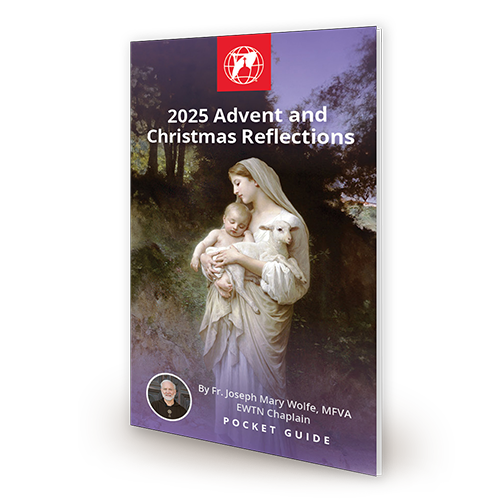
Sign up below for the free 2025 Advent and Christmas Reflections pocket guide, featuring meditations by Fr. Joseph Mary Wolfe, the EWTN Chaplain. His video series will also be sent to your email each Sunday of Advent and throughout the Christmas season. When you request the pocket guide by mail, we’ll also email you the eBook version. Or you may choose to receive just the eBook version and video series.
Send me the Physical Pocket Guide
Only available to homes in the U.S.A., while supplies last.
Send me the eBook
Be inspired to follow in the footsteps of the saints. Subscribe to receive the Daily Saint, featuring a brief biography delivered to your inbox each day.
Start now and let the intercession and witness of the saints draw you closer to God.

As we deepen our relationship with the Eternal Word, Jesus Christ, we grow in grace and are transformed by His love and mercy.
STEP 1
We’re here to serve you. Let us help you complete your gift with confidence.

Send a message to Mission Advancement.

Guidance for DAFs, stock, IRA, and more.

Manage your gifts and preferences.