

Your Faith Journey with EWTN
As we deepen our relationship with the Eternal Word, Jesus Christ, we grow in grace and are transformed by His love and mercy.
c. 6 A.D.–c. 100 A.D.
Patron Saint of love, loyalty, friendships, authors, booksellers, burn victims, poison victims, art dealers, editors, publishers, scribes, examinations, scholars, theologians, against jealousy and envy, Asia Minor

“My dear children, love one another.”
According to St. Jerome, these words are what the “beloved disciple” St. John said repeatedly to the churches he visited in Ephesus toward the end of his life. When asked why he continued to repeat the phrase, he replied, “Because it is the precept of the Lord, and if you comply with it, you do enough.”
St. John was one of the Twelve Apostles and the author of the Gospel of John, three Epistles, and the Book of Revelation. With his brother St. James, he was called by Jesus from his father’s fishing boat on the Sea of Galilee.
Tradition holds that St. John was the youngest of the Apostles. At the foot of the Cross, St. John received a special commission when Jesus entrusted His Mother, the Blessed Virgin Mary, to his care, making him the first of her countless spiritual children.
After the Resurrection, St. John helped lead the Church in Jerusalem before moving to Ephesus, where he continued to preach and establish churches. After the Resurrection, St. John became one of the three pillars of the young Church. His confirmation of St. Paul’s mission to the Gentiles, along with St. Peter and St. James, was essential.
Persecution continued to be a present danger for the followers of Christ. They were detained, threatened, arrested, and scourged. St. John and St. Peter were arrested for healing a man who was lame. Yet they continued to fulfill the commission Christ had given them.
Unlike the other Apostles, St. John was not martyred but lived to the age of 100. According to tradition, he was sentenced to death by being boiled in oil, but God protected him, and he was not harmed. Instead, he was sentenced to imprisonment on the Island of Patmos, where he received a vision that he recorded in the Book of Revelation.
Many miracles were reported at his gravesite, and even in the sixth century, dust from the tomb of St. John in Ephesus was sought for its healing powers.
According to St. Clement of Alexandria and the historian Eusebius, St. John visited one of the churches in Asia Minor. While there, St. John spotted a young man with promise and left him in the care of the bishop, instructing him to oversee the young man’s instruction and discipline. The bishop, seeing the young man was doing well, relaxed his vigilance over him. Soon, the young man was lured into a life of sin, and he became the leader of a band of thieves.
Upon his return, St. John heard the news and immediately left for the thief’s hideout in the mountains. At risk of being killed, St. John expressed to the young man God’s love for him and pleaded that he repent and return to the Sacraments. The young man, in shame, remained silent. St. John offered to lay down his life for him, just as Christ laid down His life for all. Crying, the young man fell to the ground and returned with St. John to a life of holiness. St. John did not leave until the young man was reconciled to the Church, having received absolution and participated in the Sacraments.
According to the early Church fathers, St. John’s emphasis on Christ’s divinity in his Gospel may have been a response to the spread of blasphemies. Ebion and Cerinthus denied the divinity of Christ and argued that Our Lord could not have existed before His birth. Additionally, St. John sought to include information omitted in the other three Gospels; therefore, his Gospel includes fewer miracles with more detail and some different miracles, such as the raising of Lazarus from the dead and the miracle of turning water into wine at Cana.
His exile on the Island of Patmos is believed to have lasted about two years. He was sentenced around the year 94 by Emperor Domitian for what was intended to be a life sentence. In the year 96, Domitian was killed, and his successor, Emperor Nerva, declared all Domitian’s edicts and public acts void and excessively cruel. As a result of that declaration, St. John’s sentence was revoked, and he was released.
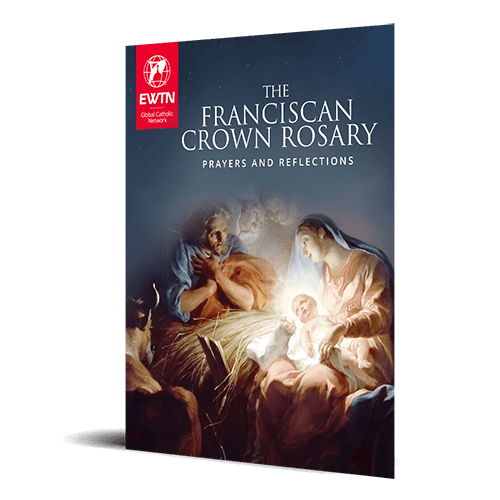
One unique devotion of the Franciscans is a seven-decade rosary known as the Franciscan Crown. While the traditional rosary consists of 5 decades which meditate on 15 mysteries, the 7-decade Franciscan Rosary, known as the Franciscan Crown, is a Rosary consisting of seven decades with each decade describing a particular joy from the life of the Blessed Virgin Mary. We hope that this special resource will help you meditate on each of the Seven Joys of Our Blessed Mother Mary.
An original docudrama on the life and spirituality of John the Evangelist, the apostle who witnessed the Transfiguration of Jesus, stood with Mary at the foot of the Cross, and wrote the Gospel and the Book of Revelation.
Be inspired to follow in the footsteps of the saints. Subscribe to receive the Daily Saint, featuring a brief biography delivered to your inbox each day.
Start now and let the intercession and witness of the saints draw you closer to God.

As we deepen our relationship with the Eternal Word, Jesus Christ, we grow in grace and are transformed by His love and mercy.
STEP 1
We’re here to serve you. Let us help you complete your gift with confidence.

Send a message to Mission Advancement.

Guidance for DAFs, stock, IRA, and more.

Manage your gifts and preferences.