

Your Faith Journey with EWTN
As we deepen our relationship with the Eternal Word, Jesus Christ, we grow in grace and are transformed by His love and mercy.
c. 274–March 12, 295
Patron Saint of soldiers, persecuted Christians, conscientious objectors

“My army is the army of God, and I cannot fight for this world. I tell you I am a Christian.”
These were the words of St. Maximilian, a courageous Christian soldier in the late third century who gave his life rather than renounce his faith under pressure to comply with Roman law.
Born in Tebessa, Algeria, St. Maximilian’s father, a Christian named Fabius Victor, served in the Roman army. Because of his father’s military service, the Roman military expected St. Maximilian to comply with the law requiring all men to register for military duty at age 21.
St. Maximilian was tried, and those present at the trial were bewildered by St. Maximilian’s calm assurance in his Faith as he explained the reason for his refusal to enlist, exhibiting no fear of death. The Roman court made several attempts to persuade him to change his mind, offering him a higher-ranking position because of his noble birthright, but he refused. They tried reasoning with him, questioning that if other soldiers who were Christians served the Roman army, why couldn’t he? St. Maximilian calmly replied that he could only answer on his own behalf and that, as a Christian soldier, he served God alone, not the world. Repeatedly, he proclaimed with great conviction his total allegiance to Jesus Christ.
Finally sentenced to death by beheading, St. Maximilian accepted the pronouncement with the inner peace of a man who knew that his soul would not die but be with Christ for eternity.
St. Maximilian was beheaded on March 12, 295, remaining faithful to Christ to the end. His father, who witnessed his martyrdom, left rejoicing and thanking God for the gift of his son, which had now been offered to Heaven.
St. Maximilian of Tebessa was venerated in the early Church as a martyr for refusing to serve in an idolatrous, pagan empire. His story is considered the earliest record of a Christian conscientious objector, with accounts of his trial and execution circulating from the late third century onward. His relics were buried near St. Cyprian, indicating that the early Church venerated him. The Acta Maximiliani (Acts of Maximilian) detail his trial and martyrdom by the Roman proconsul Dion in Numidia (modern Algeria) around 295 A.D. This account was widely known and preserved, demonstrating immediate interest in his stand. St. Maximilian was buried near the relics of St. Cyprian in Carthage, a significant site of early Christian veneration that underscored the importance of his martyrdom. His refusal highlighted the tension between Christian Faith and imperial military demands, especially concerning the pagan oaths and idolatry associated with Roman service.
Groups honoring St. Maximilian of Tebessa as a patron of conscientious objectors include the Order of Maximilian, a group of Catholic priests formed during the Vietnam War and named in his honor for his timeless stand against worldly warfare. Various other peace organizations commemorate him at events such as International Conscientious Objectors’ Day in London, recognizing him as Christianity’s earliest-known example of conscientious objection to military service for religious reasons. St. Maximilian’s story established him as an example of a Christian conscientious objector, inspiring modern groups and events worldwide that seek to promote world peace.
St. Maximilian of Tebessa, an early Christian martyr, is the patron of conscientious objectors. While he isn’t as widely depicted as other saints, when he appears in art, he’s often shown in simple Roman attire or military dress, refusing to take an oath. Symbols used include a palm branch signifying martyrdom, a sword, or a scroll representing Scripture. Sometimes he is depicted with the Roman eagle, symbolizing his refusal to serve the emperor out of conscience. St. Maximilian is presented as a young, determined boy or man, reflecting his age (around 20) at the time of his martyrdom.
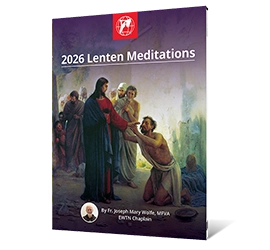
Prepare your soul for the glorious Resurrection with free weekly prayers and reflections from EWTN Chaplain Fr. Joseph Mary Wolfe, MFVA—exploring the healing power of Christ’s love. You’ll also receive weekly emails from Fr. Joseph beginning on Ash Wednesday, continuing each Sunday of Lent and Easter Sunday.
Draw closer to Our Lord as you pause, meditate, and return to Him with your whole heart.
Send me the Physical Pocket Guide
Only available to homes in the U.S.A.
Send me the
eBook
Be inspired to follow in the footsteps of the saints. Subscribe to receive the Daily Saint, featuring a brief biography delivered to your inbox each day.
Start now and let the intercession and witness of the saints draw you closer to God.

As we deepen our relationship with the Eternal Word, Jesus Christ, we grow in grace and are transformed by His love and mercy.
STEP 1
We’re here to serve you. Let us help you complete your gift with confidence.

Send a message to Mission Advancement.

Guidance for DAFs, stock, IRA, and more.

Manage your gifts and preferences.