

Your Faith Journey with EWTN
As we deepen our relationship with the Eternal Word, Jesus Christ, we grow in grace and are transformed by His love and mercy.
Martyred c. 250
Patron Saint of persecuted Christians, bishops and pastors, those suffering for the Faith

St. Nestor, Bishop of Magydos, was an early Christian martyr whose steadfast faith bore witness to Christ in the mid-third century, one of the Church’s most dangerous periods. Magydos was a city in Pamphylia, located in what is now southern Türkiye, and like many Christian communities of the time, it existed under the constant threat of persecution.
As bishop, St. Nestor served as a spiritual father to his people. He preached the Gospel, safeguarded the Church’s teachings, and encouraged the faithful to persevere amid fear and hostility. Bishops of this era carried immense responsibility, often knowing that public leadership could lead to imprisonment or death.
During an imperial crackdown on Christians, accounts say St. Nestor helped members of his flock find places of safe refuge. However, he himself did not flee or hide. He was arrested while praying in his home and brought before the authorities. He was commanded to offer a sacrifice to pagan gods as a sign of loyalty to the empire. Refusing to deny Christ, St. Nestor boldly professed his Christian Faith.
Ancient accounts testify that he suffered harsh torments such as being torn by hooks and stretched on a rack. These torments were intended to force him to abandon his faith. Instead, St. Nestor remained resolute, drawing strength from prayer and his trust in Christ. Ultimately, he was martyred by crucifixion. According to tradition, an earthquake occurred as he hung on the cross.
Magydos was significant in early Christianity because of a well-documented Christian community that existed there before Christianity was legalized in the Roman Empire. As bishop of Magydos, St. Nestor led a Christian community surrounded by pagan culture and Roman authority, making his role especially challenging during times of persecution. Archaeological evidence discovered in the nearby Roman military camp of Legio, dating to around 230 A.D., revealed the remains of what is considered one of the earliest known Christian public church buildings. This predates Constantine’s Edict of Milan, which legalized Christianity in 313 A.D., by nearly a century, showing that early Christian communities had established specific places of worship even during times of persecution.
While precise records are limited, St. Nestor is traditionally associated with the persecutions of the mid-third century, during the reign of Emperor Decius. This persecution targeted bishops, requiring them to make public sacrifices to Roman gods. Accounts of St. Nestor’s arrest say his influence in the Christian community was so significant that a Roman magistrate said, “Until we have got the better of the bishop, we shall be powerless against the Christians.”
Bishops were seen as leaders and organizers of Christian communities, making them prime targets for imperial authorities seeking to suppress the Christian movement. Removing bishops often destabilized local churches. Rome’s strategy was to target Church leaders during major Christian persecutions. Emperor Valerian, for example, ordered the execution of bishops, priests, and deacons, and Diocletian issued edicts to imprison and martyr bishops and other clergy specifically. The Roman government believed the removal of clergy would destabilize the growing Church, with bishops often arrested, tortured, exiled, or executed in systematic attempts to crush Christianity. By remaining faithful unto death, martyrs like St. Nestor strengthened the Church and affirmed the belief that Christ alone is Lord, even in the face of death.
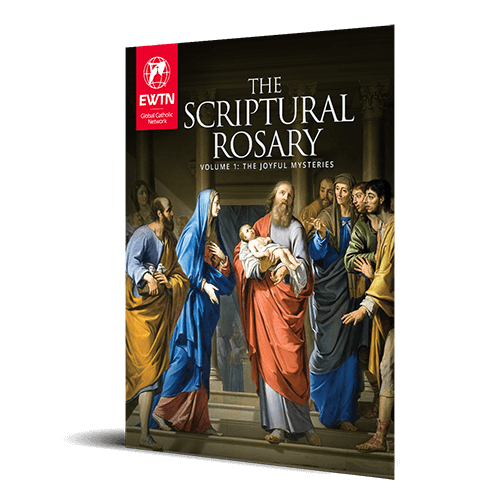
The Holy Rosary is an amazing prayer, encouraged by popes, loved by saints, and prayed by the faithful. At its heart, the Rosary is a meditation on Sacred Scripture, on the lives of Jesus and Mary.
Through this Scriptural Rosary, we hope that you will be able to better meditate on each Hail Mary and deepen your understanding of Sacred Scripture. Use the form below to get your free copy of The Scriptural Rosary.
Be inspired to follow in the footsteps of the saints. Subscribe to receive the Daily Saint, featuring a brief biography delivered to your inbox each day.
Start now and let the intercession and witness of the saints draw you closer to God.

As we deepen our relationship with the Eternal Word, Jesus Christ, we grow in grace and are transformed by His love and mercy.
STEP 1
We’re here to serve you. Let us help you complete your gift with confidence.

Send a message to Mission Advancement.

Guidance for DAFs, stock, IRA, and more.

Manage your gifts and preferences.