

Your Faith Journey with EWTN
As we deepen our relationship with the Eternal Word, Jesus Christ, we grow in grace and are transformed by His love and mercy.
c. 1007–February 22, 1072, or 1073
Patron Saint of insomnia and sleep issues, headaches, spiritual/moral struggles, Church reform and leadership, Benedictine Order

St. Peter Damian was a brilliant scholar and reformer who shaped the Church’s renewal in the eleventh century. Born in Ravenna, Italy, he was orphaned at an early age and experienced both hardship and generosity, especially from an older brother who ensured his education. St. Peter excelled in his studies and became a respected teacher, but he increasingly felt drawn to a life of prayer and solitude.
At age 28, he entered the hermitage of Fonte Avellana, where he dedicated himself to rigorous prayer, silence, and penance. St. Peter was soon assigned to lecture to his brothers. In 1043, he was named prior of the community and guided the hermits with fatherly wisdom.
At a time when the Church faced moral decline, weakened discipline, and political interference, St. Peter emerged as a powerful voice for reform. He wrote extensively, calling clergy and laity alike to holiness, integrity, and renewal. His works influenced the Great Gregorian Reform, which would shape the Church for generations.
Despite his desire for a life of solitude, St. Peter was appointed Cardinal-Bishop of Ostia by Pope Stephen IX in 1057. While he served faithfully, he repeatedly asked to return to his hermitage, preferring silence and contemplation. Eventually, he was allowed to resume his monastic life. He continued advising popes and leaders through his letters, which always urged fidelity to Christ and the Gospel.
St. Peter Damian fell ill and died on February 22, 1072, near Faenza, while returning from a diplomatic mission. Declared a Doctor of the Church in 1828, he is remembered as a champion of reform, a master of spiritual discipline, and a man who gave his life in faithful service to God.
According to his biography, St. Peter Damian had a difficult early life. His parents died when he was very young, and one of his older brothers adopted him. This brother neglected him, gave him little to eat, and forced him to work as a swineherd. Upon hearing of his maltreatment, another older brother, Damiano, an archpriest, took pity on the boy. He took him away from the other brother a few years later to be educated, providing a superior education in Faenza, Parma, and Ravenna. Growing up, St. Peter had a generous spirit toward the poor and a deep gratitude for his benefactor brother. He added “Damian” to his own name to honor his brother. His education helped him excel quickly in his studies. By age 25, St. Peter was a well-known and respected teacher and scholar. At age 28, he left his academic life to join the hermits at Fonte Avellana, beginning a long life of service to the Church.
St. Peter Damian was an uncompromising voice for moral and structural renewal in a turbulent era of Church history. He was instrumental in shaping key decisions that led to Church reform through his fervent writings and direct collaboration with reform-minded popes. As prior of a hermitage, he advocated stricter enforcement of monastic discipline and the condemnation of clerical misconduct. His reforms of monastic life influenced the broader Church. In his role as Cardinal-Bishop, he advised popes on diverse issues, including corruption among the clergy and the process of papal elections. He also defended the pope’s independence from state interference in the appointment of bishops, which impacted Church-state relations. St. Peter Damian’s theological insights, moral example, and powerful advocacy provided much of the intellectual and spiritual foundation for the renewal movement that paved the way for later reform.
St. Peter Damian appears as a character in the seventh sphere of Heaven in Dante Alighieri’s Paradiso. In Dante’s epic poem, St. Peter Damian converses with Dante. He discusses predestination and laments the decline of his order and the contemporary Church in Dante’s era. He tells Dante the souls in Heaven are not singing because their song is so beautiful that it would overwhelm Dante. Writing about 250 years after St. Peter’s death, Dante chose to honor St. Peter Damian by placing him in one of the highest heavens, recognizing his significant role as an influential monk, theologian, and cardinal committed to Church reform.
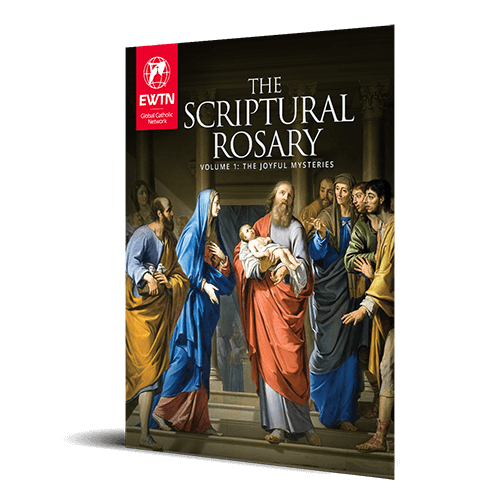
The Holy Rosary is an amazing prayer, encouraged by popes, loved by saints, and prayed by the faithful. At its heart, the Rosary is a meditation on Sacred Scripture, on the lives of Jesus and Mary.
Through this Scriptural Rosary, we hope that you will be able to better meditate on each Hail Mary and deepen your understanding of Sacred Scripture. Use the form below to get your free copy of The Scriptural Rosary.
Be inspired to follow in the footsteps of the saints. Subscribe to receive the Daily Saint, featuring a brief biography delivered to your inbox each day.
Start now and let the intercession and witness of the saints draw you closer to God.

As we deepen our relationship with the Eternal Word, Jesus Christ, we grow in grace and are transformed by His love and mercy.
STEP 1
We’re here to serve you. Let us help you complete your gift with confidence.

Send a message to Mission Advancement.

Guidance for DAFs, stock, IRA, and more.

Manage your gifts and preferences.