

Your Faith Journey with EWTN
As we deepen our relationship with the Eternal Word, Jesus Christ, we grow in grace and are transformed by His love and mercy.
69 A.D.–155 A.D.
Patron Saint of earache sufferers

St. Polycarp of Smyrna stands as one of the most illustrious figures of the early Church—an essential link through whom the Apostolic Faith was transmitted to the generations that followed.
Born around the year 69, St. Polycarp became a disciple of St. John the Apostle, from whom he received not only the teachings of Christ but also a living witness to the Gospel. This direct connection to the Apostles made him a revered authority in the Christian community.
Consecrated Bishop of Smyrna by the Apostle John in modern-day Türkiye, St. Polycarp was known for his zealous defense of authentic Christian teaching. He worked persistently to correct false doctrines that threatened the authenticity of the Faith and to preserve unity in the Church.
St. Polycarp’s martyrdom is one of the earliest fully documented accounts outside Scripture. When persecution broke out, he refused to flee, entrusting himself entirely to God’s will. Arrested and brought before the Roman authorities, he was commanded to curse Christ to save his life. His response has echoed through the centuries: “Four score and six years I have served Him, and He has done me no wrong. How then can I curse my King and Savior?”
St. Polycarp was sentenced to be burned alive, yet the flames, according to tradition, did not consume him. He was then pierced by a sword around the year 155.
St. Polycarp is one of three principal Apostolic Fathers of the early Church, along with Clement of Rome and Ignatius of Antioch, and remains a highly regarded teacher of the Faith.
During the time of St. Polycarp, various heresies had begun to challenge the early Church. St. Polycarp fervently fought to defend and preserve the Faith that the Apostles received from Christ. Two heresies he confronted were Docetism and Gnosticism. The heresy of Docetism claimed Jesus only appeared human and denied His incarnate nature. The Gnostics sought to cut, add to, or distort the New Testament, using apostolic tradition for personal gain.
St. Polycarp stood as a powerful example of fidelity to the true Faith handed down from the Apostles. While he gave eloquent arguments for the Faith, St. Polycarp also spoke clearly when engaging heretics. He defended the reality of the incarnation by telling one heretic that anyone denying Christ came in the flesh is an antichrist. And he called one Gnostic the son of Satan. His unwavering refusal to recant his faith before the Roman authorities, even unto death, stood as a powerful testament against any compromise of the Truth.
St. Polycarp left behind only one surviving letter, the Epistle to the Philippians, a significant work among the Apostolic Fathers that serves as an exhortation to Christian virtue and faith. However, he likely wrote others that are lost. This epistle, a pastoral letter encouraging faithfulness, love for God and neighbor, and adherence to Christ’s teachings, warns against heresy. The letter references many New Testament books, demonstrating the early use and authority of these texts. The account of his martyrdom, attributed to the church in Smyrna, is another crucial document associated with St. Polycarp.
St. Polycarp’s teachings reinforced fidelity to Apostolic Tradition. Grounded in his deep knowledge of the Christian Gospel, St. Polycarp’s teachings and writings established him as a vital Apostolic Father and solidified core Christian beliefs and practices for future generations. His skill in defending the Faith won over both pagans and heretics. His surrender to suffering martyrdom for the Faith became a powerful example that inspired countless Christians. St. Polycarp’s life and death, recorded in one of the earliest accounts of Christian martyrdom, demonstrated heroic discipleship and an unwavering commitment to Christ, even unto death.
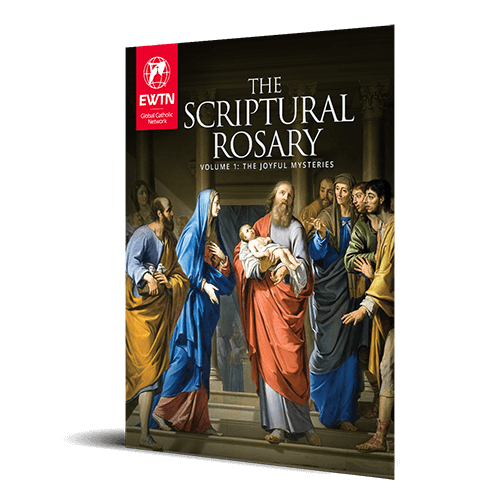
The Holy Rosary is an amazing prayer, encouraged by popes, loved by saints, and prayed by the faithful. At its heart, the Rosary is a meditation on Sacred Scripture, on the lives of Jesus and Mary.
Through this Scriptural Rosary, we hope that you will be able to better meditate on each Hail Mary and deepen your understanding of Sacred Scripture. Use the form below to get your free copy of The Scriptural Rosary.
See how the first Christians preserved the flame of Faith through the trials, teachings, and martyrdom of the early saints like Polycarp, Irenaeus, and the Martyrs of Leon.
Be inspired to follow in the footsteps of the saints. Subscribe to receive the Daily Saint, featuring a brief biography delivered to your inbox each day.
Start now and let the intercession and witness of the saints draw you closer to God.

As we deepen our relationship with the Eternal Word, Jesus Christ, we grow in grace and are transformed by His love and mercy.
STEP 1
We’re here to serve you. Let us help you complete your gift with confidence.

Send a message to Mission Advancement.

Guidance for DAFs, stock, IRA, and more.

Manage your gifts and preferences.