

Your Faith Journey with EWTN
As we deepen our relationship with the Eternal Word, Jesus Christ, we grow in grace and are transformed by His love and mercy.
Died in the late first century
Patron Saint of prisoners

St. Prisca, also known as St. Priscilla, is venerated as an early Roman virgin martyr and the foundress of the Church of St. Prisca on the Aventine Hill in Rome. While details of her life are scarce, the Church honors her as a young Christian woman who gave courageous witness to Christ in the earliest centuries of the Faith.
According to tradition, St. Prisca was a noble Roman maiden who lived during the reign of Emperor Claudius. From her youth, she professed belief in Christ and refused to worship the pagan gods of the empire.
At the age of 13, St. Prisca was brought to the emperor, who intended to take her as his concubine. He demanded that St. Prisca make a sacrifice to the Roman god Apollo. She courageously refused to worship the pagan deity, knowing that her refusal would lead to her death.
Because of St. Prisca’s steadfast confession of faith, she was imprisoned and condemned to death. According to tradition, she suffered many tortures. She was scourged, tormented with boiling fat, and hooked and stretched on a rack. After each torture, she refused to deny her faith.
She was then thrown into the amphitheater to be devoured by a lion, but the beast would not harm her; instead, it humbly crouched at her feet. Finally, St. Prisca was beheaded for her faith, becoming one of the first Roman virgin martyrs.
A church on the Aventine Hill, Titulus Priscillae, stands on the site believed to be where St. Prisca lived. Her steadfast fidelity to Truth and her courage, even unto death, show that true strength is not found in power or influence, but in unshakable faith and fervent love that unites the soul with Christ, even amid trial and persecution.
There were two Priscillas martyred during the first century. St. Prisca, a virgin martyr, is often confused with St. Priscilla, the wife of Aquila, who assisted St. Paul in his missionary work (see Acts 18:2). Most scholars believe these were two distinct individuals living around the same time. Both women were known by both names (Prisca and Priscilla). The other St. Priscilla was also martyred along with her husband, St. Aquila. She was an early Christian missionary and a friend of St. Paul.
The Church of St. Prisca, built over an ancient Roman home, is one of the oldest Christian sites in Rome. It stands as a testimony to the early house-church communities that gathered in secret to worship Christ. Archaeological studies show that this house-church may date to the earliest Christian community in Rome.
The sentence of damnatio ad bestias, which is Latin for condemnation to beasts, was a form of Roman capital punishment used for both ordinary criminals and Christians. There are no records of how many Christians were sentenced to death in this way. The sentence involved a condemned person being thrown to wild animals as a public spectacle, and the punishment was typically applied to lower classes, slaves, the worst criminals, and those who were not Roman citizens. Christians also faced this form of punishment during persecution as a form of public execution. While citizens might receive a swifter death, like beheading, slaves and lower-class individuals were more likely to be subjected to death by beasts, usually lions or other large cats.
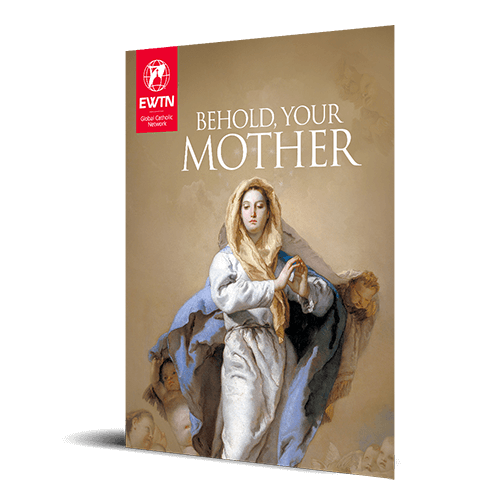
We hope this special eBook will draw you closer to our Blessed Mother and her Son, Jesus Christ. We trust that the pages will bring your heart under her mantle, as we share a few of the beautiful and befitting names bestowed upon the Blessed Virgin Mary.
Be inspired to follow in the footsteps of the saints. Subscribe to receive the Daily Saint, featuring a brief biography delivered to your inbox each day.
Start now and let the intercession and witness of the saints draw you closer to God.

As we deepen our relationship with the Eternal Word, Jesus Christ, we grow in grace and are transformed by His love and mercy.
STEP 1
We’re here to serve you. Let us help you complete your gift with confidence.

Send a message to Mission Advancement.

Guidance for DAFs, stock, IRA, and more.

Manage your gifts and preferences.