

Your Faith Journey with EWTN
As we deepen our relationship with the Eternal Word, Jesus Christ, we grow in grace and are transformed by His love and mercy.
Died 720 A.D.
Patron Saint of pilgrims

St. Richard the Pilgrim is honored as a holy traveler whose quiet faith left a lasting mark on the Church in England and across Europe. Although few details are known about his life, St. Richard is traditionally remembered as the father of three well-known saints: St. Willibald, St. Winnibald, and St. Walburga.
According to tradition, St. Richard was an English nobleman—possibly a prince or even a minor king who rejected his royal inheritance to embrace a life of simplicity, piety, and devotion to God. After the death of his wife, he guided his children in the Christian Faith and encouraged them to seek holiness above worldly honor.
In the late 720s, St. Richard set out on a long pilgrimage. Entrusting his eleven-year-old daughter to the Abbess of Wimborne, he sailed with his sons Willibald and Winnibald to Rome and the Holy Land. Medieval sources describe him as a man of deep piety and humility who desired nothing more than to follow Christ.
St. Richard never completed the journey. He fell ill and died at Lucca, Italy, where the people recognized his royal line and reputation for sanctity and began to honor him as a holy pilgrim. His sons buried him at the Church of St. Frediano in Lucca, Italy, and completed his pilgrimage. His tomb became a place of prayer and intercession, drawing pilgrims from across Europe.
St. Richard’s legacy lived on through his children’s missionary work. Willibald became the first Bishop of Eichstätt, Germany. Winnibald founded monasteries in Germany and implemented reforms. Walburga became an abbess and later assumed the role of superintendent of a double monastery for both men and women after her brother’s death. St. Richard’s children helped spread Christianity in central Europe and became saints.
St. Richard’s life exemplifies holiness that often grows not through remarkable achievements but through fidelity to God’s call in the ordinary routines of daily life—especially within the family.
St. Richard’s legacy is most visible in Germany through the missionary work of his sons. St. Willibald served as Bishop of Eichstätt, while St. Winnibald founded monasteries in Bavaria and served as a monastic reformer. Their sister, St. Walburga, later joined them, serving as abbess of the nuns at the Heidenheim Monastery, a double monastery for both men and women founded by her brother, Winnibald. After Winnibald’s death, his sister Walburga became the superintendent of both men and women at the monastery. St. Richard’s children became key figures in the country’s Christianization. They worked alongside St. Boniface, the “Apostle to the Germans.” Due to his children’s contributions, St. Richard is venerated in Germany and depicted in religious artwork alongside his saintly children, particularly in the Diocese and City of Eichstätt.
St. Richard was buried in the Church of San Frediano in Lucca, Italy, after he died there during his pilgrimage to Rome and the Holy Land. Some of his relics remain in the church. Miracles reported at his tomb shortly after his death helped to establish his veneration. The tomb became a significant destination for pilgrims, especially those from Britain and Germany. Other portions of St. Richard’s relics were moved to Eichstätt, Germany, at the request of his son, St. Willibald, who was the first bishop there. His relics are now divided, with parts in both Eichstätt, Germany, and Lucca, Italy. The San Frediano Church in Lucca remains a significant shrine to St. Richard. In Germany, St. Richard is depicted with his sons at the Eichstätt Cathedral, and some of his relics are held in the reliquary chapel there.
St. Richard the Pilgrim’s sons continued the pilgrimage to Rome and the Holy Land after their father’s death and burial. Willibald eventually reached the Holy Land, and this account was recorded by St. Richard’s niece, Hygeburg, in her work titled Hodoeporicon. Willibald spent several years in the Holy Land visiting holy Christian sites and studying documents from the early Church councils. After seven years, he returned to Italy, where he was ordained a priest and sent to Germany to organize missionary work. He was later named Bishop of Eichstätt. His brother, Winnibald, accompanied Willibald to Asia Minor but returned to Rome and lived in a monastery after Willibald departed for Palestine. He later joined his brother in missionary work in Germany, where he established several monasteries.
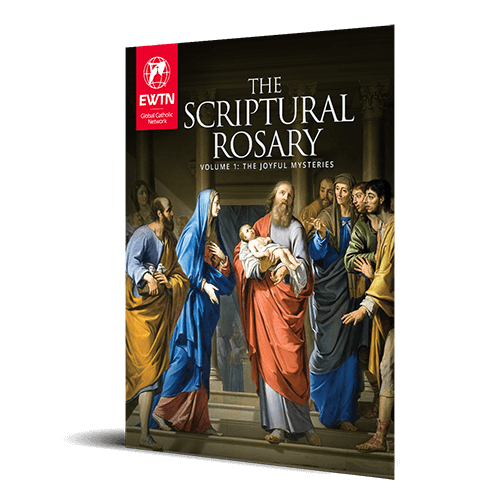
The Holy Rosary is an amazing prayer, encouraged by popes, loved by saints, and prayed by the faithful. At its heart, the Rosary is a meditation on Sacred Scripture, on the lives of Jesus and Mary.
Through this Scriptural Rosary, we hope that you will be able to better meditate on each Hail Mary and deepen your understanding of Sacred Scripture. Use the form below to get your free copy of The Scriptural Rosary.
Be inspired to follow in the footsteps of the saints. Subscribe to receive the Daily Saint, featuring a brief biography delivered to your inbox each day.
Start now and let the intercession and witness of the saints draw you closer to God.

As we deepen our relationship with the Eternal Word, Jesus Christ, we grow in grace and are transformed by His love and mercy.
STEP 1
We’re here to serve you. Let us help you complete your gift with confidence.

Send a message to Mission Advancement.

Guidance for DAFs, stock, IRA, and more.

Manage your gifts and preferences.