

Your Faith Journey with EWTN
As we deepen our relationship with the Eternal Word, Jesus Christ, we grow in grace and are transformed by His love and mercy.
c. 255–c. 288
Patron Saint of soldiers, athletes, archers, plague-stricken people, disabled people, a holy death

St. Sebastian is one of the Church’s most beloved early martyrs—a soldier who served the Roman army with valor, yet whose deepest loyalty was to Christ. Born in the late third century, he was, according to tradition, a native of Milan and entered the imperial army under Emperor Diocletian. He rose in rank to serve as a Captain in the Praetorian Guard. Outwardly, St. Sebastian lived as a loyal Roman officer but hid a secret life as a Christian. He used his position to encourage and aid fellow believers who were imprisoned for their faith.
Tradition says that two Christian brothers on death row were being convinced by the pleas of their parents and friends to renounce their faith and save their lives. St. Sebastian, seeing the brothers weakening, gave an eloquent defense of the Truth of the Faith, converting not only the family members, but also the jailer and other prisoners. He then converted the prison warden by healing his wife, who had been mute for six years, from palsy. St. Sebastian also converted an additional 16 prisoners that day.
When he was exposed as a Christian, St. Sebastian was brought before the emperor, who reproached him for betrayal. Refusing to renounce Christ, he was condemned to die by being tied to a stake and shot with arrows. Witnesses said he appeared “like a hedgehog, covered with quills.” Believing him dead, the soldiers left, but a Christian widow named Irene found him alive and nursed him back to health.
Once recovered, St. Sebastian boldly confronted Diocletian again, denouncing his cruelty toward Christians. The emperor, enraged, ordered that St. Sebastian be beaten to death with clubs and his body thrown into Rome’s sewers. His fellow Christians retrieved his remains and buried him along the Appian Way, where the Basilica of St. Sebastian now stands.
For centuries, Christians have honored St. Sebastian as one of the most illustrious martyrs. Under his patronage against plagues, he was invoked for intercession in Rome (680), Milan (1575), and Lisbon (1599). The plagues were halted, and the people were freed from the pestilence. His life calls us to steadfast faith even amid persecution or devastation.
The women named Irene and Lucina are venerated as saints. Their actions in relation to St. Sebastian are described in the traditional accounts of St. Sebastian’s martyrdom found in a fifth-century biography about him called the Passio Sancti Sebastiani. St. Irene was the wife of St. Castulus, a Christian martyr. She cared for St. Sebastian after he was shot with arrows and left for dead. St. Lucina is associated with a wealthy Roman noblewoman who converted to Christianity and courageously provided Christian martyrs with proper burials in the catacombs, as she did for St. Sebastian. It is believed that she was Pomponia Graecina, wife of Aulus Plautius, and that “Lucina” was her baptismal name. The Crypt of Lucina, the oldest part of the Catacombs of St. Callistus, is named after her. It is believed she was the original donor of the land for the catacomb.
St. Sebastian converted several prisoners, visitors, and even the prison staff to Christianity. Nicostratus, who was in charge of prisoners, took the converted prisoners to his house, where they were instructed and baptized. Chromatius, the governor of Rome, was informed of what had happened. Finding out that St. Sebastian cured the father of the two brothers on death row from gout, he sent for St. Sebastian, since he too suffered from gout. After being healed, he also converted to Christianity. He quit his job, moved to the country, and took many new converts with him. St. Sebastian was sentenced to death by arrows as a traitor to Rome and left for dead, but later recovered.
However, the persecutions continued. Zoe, the wife of Nicostratus, was the first to be arrested and martyred for praying at St. Peter’s tomb. Most of those whom St. Sebastian had converted to Christianity at the prison were captured and put to death. After healing from his wounds, St. Sebastian confronted the emperor. He waited by a staircase and rebuked Diocletian for his cruel treatment of Christians. The emperor, initially surprised to see a dead man alive, quickly recovered and ordered St. Sebastian clubbed to death. After having sent so many martyrs to Heaven before him, St. Sebastian was taken in glory to his reward.
Built along the Appian Way in Rome, the basilica marks the place of St. Sebastian’s burial. The Basilica of St. Sebastian is a historic church in Rome, part of the Seven Pilgrim Churches of Rome. The relics of St. Sebastian are housed in the ground-level basilica, though his original resting place was in the catacombs beneath the church. The church was built in the fourth century by Emperor Constantine. Used to house relics of Sts. Peter and Paul during a time of persecution, it was first called the Basilica of the Apostles. It was rededicated to St. Sebastian, a venerated Christian martyr, in the ninth century.
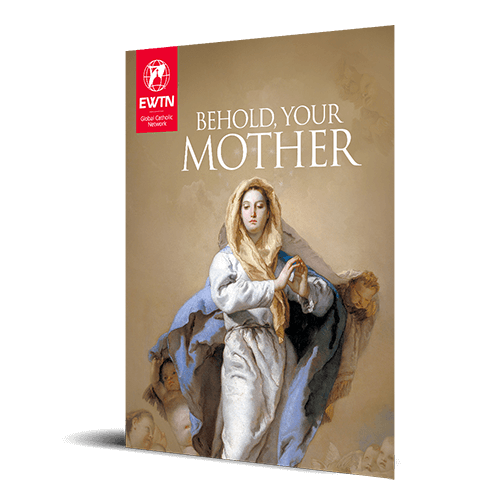
We hope this special eBook will draw you closer to our Blessed Mother and her Son, Jesus Christ. We trust that the pages will bring your heart under her mantle, as we share a few of the beautiful and befitting names bestowed upon the Blessed Virgin Mary.
Be inspired to follow in the footsteps of the saints. Subscribe to receive the Daily Saint, featuring a brief biography delivered to your inbox each day.
Start now and let the intercession and witness of the saints draw you closer to God.

As we deepen our relationship with the Eternal Word, Jesus Christ, we grow in grace and are transformed by His love and mercy.
STEP 1
We’re here to serve you. Let us help you complete your gift with confidence.

Send a message to Mission Advancement.

Guidance for DAFs, stock, IRA, and more.

Manage your gifts and preferences.