

Your Faith Journey with EWTN
As we deepen our relationship with the Eternal Word, Jesus Christ, we grow in grace and are transformed by His love and mercy.
1225–March 7, 1274
Patron Saint of theologians, philosophers, apologists, booksellers, academics, Catholic academies, schools and universities, publishers, scholars/students, chastity, against lightning/storms

St. Thomas Aquinas ranks among the greatest theologians and philosophers in the history of the Church. Known as the “Angelic Doctor,” his profound faith and intellectual brilliance gave the Church a synthesis of reason and revelation that continues to influence Catholic teaching today.
St. Thomas was born around 1225 in Italy to a noble family. Educated first by Benedictines at Monte Cassino and later at the University of Naples, he was drawn to the newly founded Dominican Order. His family opposed his vocation and kept him confined for more than a year. St. Thomas’s quiet resolve prevailed, and he joined the Dominicans in 1244.
St. Thomas’s education shaped his disciplined, contemplative approach to theology. His writings, like the Summa Theologiae, integrated Aristotle’s philosophical concepts with Christian theology to develop a synthesis of faith and reason. St. Thomas also wrote on the nature of virtue, grace, and Christ’s True Presence in the Eucharist.
St. Thomas composed several Eucharistic hymns, including Pange Lingua and Tantum Ergo, still sung during Benediction. In 1274, while traveling to the Second Council of Lyons, he fell ill and died at the Cistercian Abbey of Fossano. He was canonized in 1323 and declared a Doctor of the Church in 1567.
The vast legacy of writings left behind by St. Thomas Aquinas is estimated to be more than eight million words. His clarity of thought, purity of heart, and love for Christ and the Eucharist continue to inspire all who seek truth.
St. Thomas Aquinas is known as the Angelic Doctor because he wrote extensively on the nature of angels and their activities. He described the hierarchy of angels as being divided into nine choirs, each of which is further divided into three categories. He explained that each category of angels had a specific function and a corresponding level of affinity to both God and humanity. St. Thomas’s title of Angelic Doctor also reflects St. Thomas’s holiness and profound wisdom, which illuminated divine truth, in some ways, similar to the angels who contemplate God.
St. Thomas Aquinas wrote hymns about the Eucharist primarily at the request of Pope Urban IV, who wanted to establish a solemn, universal feast day dedicated to the Eucharist to deepen the faithful’s love and belief in the Real Presence of Christ. He wrote eight hymns for liturgical use. St. Thomas’s hymns are poetic expressions of the complex theology he explored in his scholarly works. The beauty and mystery of the hymns inspire profound devotion and reverence for Christ in the Blessed Sacrament. These well-known hymns are still in use today. They include “Praise, Zion, Your Savior” (Lauda Sion Salvatorem), “Sing, My Tongue, the Savior’s Glory” (Pange Lingua Gloriosi), “Therefore So Great a Sacrament” (Tantum Ergo), “At This Sacred Table” (Sacris Solemniis), “Bread of Angels” (Panis Angelicus), “The Word Descending from Above” (Verbum Supernum Prodiens), “O Saving Victim” (O Salutaris Hostia), and “I Devoutly Adore You” (Adoro Te Devote).
According to Catholic tradition, St. Thomas Aquinas is said to have performed many miracles during his life and after his death. One account said a woman was miraculously cured after she touched his garment while he was praying in a crowd. Another story claims he threw water in the air, and it floated in mid-air, defying the laws of gravity. Another story tells that during a storm, he and his companions were saved from a shipwreck when they asked Thomas for help, and a new wind arose, moving them to safety. Witnesses reported his mystical experiences, including seeing him levitate in prayer, and during a vision, Christ is said to have spoken to him. After his death, a man who had been paralyzed for years regained the use of his limbs after visiting St. Thomas’s tomb. It was recorded that a sweet odor of roses filled the chapel and monastery after his death, and a blind sub-prior was healed after touching his body. People visiting his tomb reported receiving visions and healings.
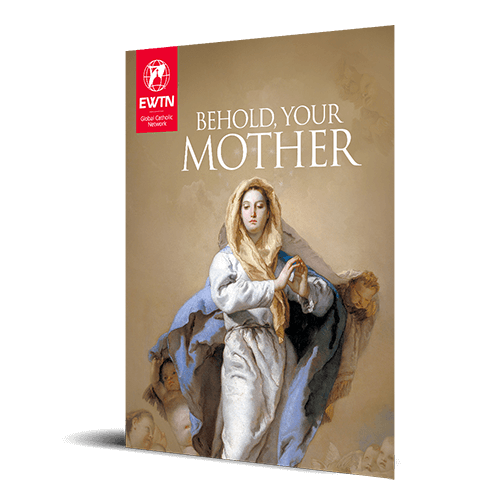
We hope this special eBook will draw you closer to our Blessed Mother and her Son, Jesus Christ. We trust that the pages will bring your heart under her mantle, as we share a few of the beautiful and befitting names bestowed upon the Blessed Virgin Mary.
Thomas Aquinas was a theologian, scripture scholar, philosopher, and saint who became a Doctor of the Church due to the lasting value of his writings and the immense scope of his gifts.
Thomas Aquinas is summoned to Rome to train young theologians and develops Summa Theologiae, one of the most significant and influential works in the history of Christian thought.
Sergio brags about winning the ‘Excellency on Research Award,’ but learns a more important lesson from St. Thomas Aquinas, who was smart, yet humble. It helps Sergio understand that his intelligence is a gift from God. (Animated)
St. Thomas Aquinas gives an interview with host Richard Payne, and the 13th-century saint answers questions from a modern-day audience.
Be inspired to follow in the footsteps of the saints. Subscribe to receive the Daily Saint, featuring a brief biography delivered to your inbox each day.
Start now and let the intercession and witness of the saints draw you closer to God.

As we deepen our relationship with the Eternal Word, Jesus Christ, we grow in grace and are transformed by His love and mercy.
STEP 1
We’re here to serve you. Let us help you complete your gift with confidence.

Send a message to Mission Advancement.

Guidance for DAFs, stock, IRA, and more.

Manage your gifts and preferences.