

Your Faith Journey with EWTN
As we deepen our relationship with the Eternal Word, Jesus Christ, we grow in grace and are transformed by His love and mercy.
November 16, 1538–March 23, 1606
Patron Saint of Latin American bishops; rights of indigenous people; Lima, Peru; Valladolid, Spain

St. Turibius of Mogrovejo was a 16th-century Spanish-born professor of law who became one of the most influential missionaries and bishops in the Americas. Born in Mayorga, Spain, he studied law and taught at the University of Salamanca in Spain.
A brilliant scholar, St. Turibius later served as a judge for the Inquisition in Granada. When the Church needed an Archbishop of Lima, Peru, in 1579, the pope appointed him to the position. While he tried to decline the offer, he eventually accepted out of obedience to the pope. He received Holy Orders and was later ordained a bishop.
Upon arrival in Lima, St. Turibius found a diocese in need of pastoral care, organization, and evangelization. He traveled frequently throughout his archdiocese, often covering hundreds of miles on foot or horseback to reach remote villages. St. Turibius preached, administered the Sacraments, personally oversaw the formation of clergy, baptized converts, and confirmed half a million souls over two and a half decades.
A staunch advocate for the plight of the indigenous peoples of Peru, St. Turibius defended their rights against exploitation and injustice, insisting that they receive fair treatment and proper catechesis. He also founded schools, seminaries, and charitable institutions, ensuring that education and the Faith would flourish in South America.
Through his reforms, preaching, and compassionate leadership, St. Turibius strengthened the Church’s presence in Peru and cultivated a deep respect for the dignity of every person. He brought to his work intellectual rigor, pastoral care, and zeal for evangelization, making him a model bishop and missionary.
St. Turibius died in Lima, Peru, on March 23, 1606, from a fever contracted during a pastoral visit. He was canonized in 1726. His reforms strengthened the Church’s presence in the New World and ensured that Christian teaching reached both European settlers and native populations. His virtuous life inspired many to sainthood, including St. Martin de Porres and St. Rose of Lima.
St. Turibius of Mogrovejo defended the indigenous people of Peru by fiercely challenging the mistreatment and exploitation of native populations by colonists. He insisted that they be treated with respect, receive proper catechesis, and have access to the Sacraments. He advocated for legal and pastoral remedies for abuses, ensuring that their human dignity and spiritual welfare were protected. He directly confronted Spanish authorities and masters, acting as a champion of native rights against injustices, which drew significant opposition. To better evangelize and understand the people, he learned their native languages, a rare practice for the time. St. Turibius commissioned a trilingual catechism in Spanish, Quechua, and Aymara, making religious instruction accessible to all. He disciplined corrupt priests and improved priestly training. In 1591, he founded the first seminary of the Americas in Lima.
To strengthen the Church and improve clergy formation, St. Turibius founded various essential institutions. He established the first seminary in the Western Hemisphere in Lima, Peru, around 1591. He also built numerous schools, hospitals, and churches. He learned local languages to educate better and catechize indigenous peoples, promoting their integration into the Church. St. Turibius improved the quality of life for people in South America during his time as Archbishop. These foundational institutions defined his educational legacy in Peru and beyond.
St. Turibius of Mogrovejo knew and interacted with both St. Rose of Lima and St. Martin de Porres. St. Turibius’s extensive missionary journeys, often on foot, brought him into contact with many future holy figures, including these two, to whom he ministered directly. He baptized and confirmed both saints during his parish visits across his vast archdiocese. They became the first saints of the New World to be canonized, and his work as archbishop laid the groundwork for their sanctity.
When St. Turibius arrived in Lima, the Archdiocese of Lima was geographically immense, covering roughly 1.34 million square kilometers (more than 500,000 square miles) of challenging terrain, including mountains, jungle, and coast, stretching about 400 miles along the Peruvian coast and deep into the Andes. This made his extensive pastoral visitations incredibly arduous—but essential for evangelizing and protecting the indigenous populations. St. Turibius traveled these vast distances, often on foot, through dangerous conditions, visiting remote areas over the years to provide spiritual care and administer the Sacraments.
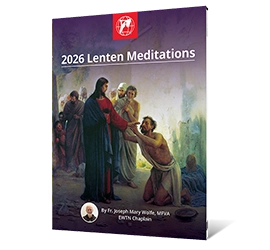
Prepare your soul for the glorious Resurrection with free weekly prayers and reflections from EWTN Chaplain Fr. Joseph Mary Wolfe, MFVA—exploring the healing power of Christ’s love. You’ll also receive weekly emails from Fr. Joseph beginning on Ash Wednesday, continuing each Sunday of Lent and Easter Sunday.
Draw closer to Our Lord as you pause, meditate, and return to Him with your whole heart.
Send me the Physical Pocket Guide
Only available to homes in the U.S.A.
Send me the
eBook
Be inspired to follow in the footsteps of the saints. Subscribe to receive the Daily Saint, featuring a brief biography delivered to your inbox each day.
Start now and let the intercession and witness of the saints draw you closer to God.

As we deepen our relationship with the Eternal Word, Jesus Christ, we grow in grace and are transformed by His love and mercy.
STEP 1
We’re here to serve you. Let us help you complete your gift with confidence.

Send a message to Mission Advancement.

Guidance for DAFs, stock, IRA, and more.

Manage your gifts and preferences.