

Your Faith Journey with EWTN
As we deepen our relationship with the Eternal Word, Jesus Christ, we grow in grace and are transformed by His love and mercy.
Died in 303 A.D.

St. Zeno of Nicomedia was a Roman soldier and commander during the reign of Emperor Diocletian, when some of the most severe persecutions of Christians in the Roman Empire took place. His courage to declare his Christian faith amid unprecedented Roman persecution led to his crown of martyrdom.
St. Zeno was assigned to duty in Nicomedia, Bithynia (modern-day Türkiye), a center of Roman imperial administration. His status as a regiment commander placed him close to the imperial court. Yet as a Christian, St. Zeno endured the pain of the atrocities inflicted on Christians. According to tradition, on Christmas Day in 303 A.D., the emperor ordered thousands of Christians to be burned alive in a church.
Following the incident, as Emperor Diocletian made a sacrifice to the goddess Ceres in a public celebration, St. Zeno, whose Christian faith forbade reverence to pagan deities, openly laughed at what he saw as empty godlessness. For this act of public mockery of the imperial worship, he was arrested and severely tortured. His jaw was shattered, and his teeth were pulled out. St. Zeno was beheaded for refusing to renounce his faith.
Although many details are sparse and drawn from tradition, St. Zeno’s story stands as a powerful testament to courage, conviction, and fidelity in the face of brutal and unjust authority. St. Zeno did not hide his faith; instead, in a moment when silence or compromise might have saved his life, he stayed faithful to Christ—even when the consequence was death.
St. Zeno is sometimes also commemorated among the “20,000 Martyrs of Nicomedia,” a large group of Christians who suffered in that city during the persecution of Emperor Diocletian.
The persecution ordered by Diocletian in 303 A.D. included the destruction of churches and Christian writings and forced sacrifices to pagan gods. In Nicomedia, after an edict was issued ordering these things, many Christians were accused and punished. A fire in the imperial palace was blamed on Christians, which the emperor used as a reason for further aggression. According to tradition, as many as 20,000 Christians are said to have been burned alive in Nicomedia when they gathered in a church on Christmas Day.
Mocking the emperor’s sacrifice was a bold act for several reasons. Such sacrifices were public affirmations of loyalty to the Roman gods and the empire, upholding the social order. By ridiculing the ritual and rejecting paganism, St. Zeno challenged the emperor’s divine authority. He also revealed his belief in the Christian Faith, identifying him as a traitor to Rome.
The accounts of St. Zeno’s martyrdom in Nicomedia, his role as a soldier, and his execution after mocking a pagan sacrifice are recorded, but specific elements, such as how he was executed, vary. St. Zeno was martyred in 303 A.D during a public religious ceremony where Emperor Diocletian was offering a sacrifice to the pagan goddess Ceres. St. Zeno openly ridiculed the Emperor’s devotion to the goddess. He was then arrested, tortured, and beheaded. Reported details of the torture vary.
The historian Eusebius, an eyewitness, confirms that the persecution in Nicomedia began in 303 A.D. with the razing of a church, the burning of Scriptures, and the execution of many Christians. Tradition says St. Zeno was martyred on Christmas Day, the same day 20,000 Christians gathered in a church to worship and were all burned alive. Other accounts say St. Zeno was martyred sometime later during the festival of a pagan goddess.
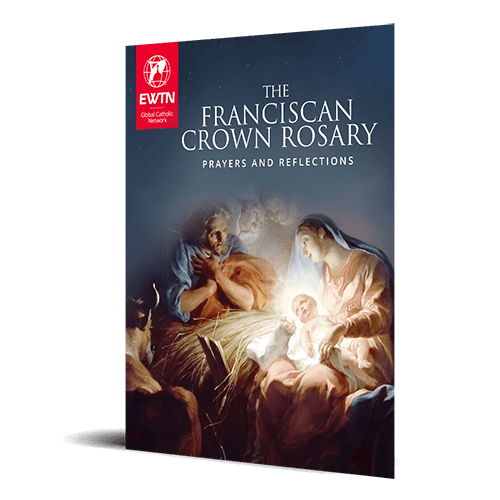
One unique devotion of the Franciscans is a seven-decade rosary known as the Franciscan Crown. While the traditional rosary consists of 5 decades which meditate on 15 mysteries, the 7-decade Franciscan Rosary, known as the Franciscan Crown, is a Rosary consisting of seven decades with each decade describing a particular joy from the life of the Blessed Virgin Mary. We hope that this special resource will help you meditate on each of the Seven Joys of Our Blessed Mother Mary.
Be inspired to follow in the footsteps of the saints. Subscribe to receive the Daily Saint, featuring a brief biography delivered to your inbox each day.
Start now and let the intercession and witness of the saints draw you closer to God.

As we deepen our relationship with the Eternal Word, Jesus Christ, we grow in grace and are transformed by His love and mercy.
STEP 1
We’re here to serve you. Let us help you complete your gift with confidence.

Send a message to Mission Advancement.

Guidance for DAFs, stock, IRA, and more.

Manage your gifts and preferences.