

Your Faith Journey with EWTN
As we deepen our relationship with the Eternal Word, Jesus Christ, we grow in grace and are transformed by His love and mercy.
Born in the first century B.C. and died in the early first century A.D.
Patron Saint of childless couples, pregnant women, and those facing difficulties conceiving

St. Elizabeth, a descendant of Aaron, and her husband St. Zechariah, a priest of the Temple, are introduced in the Gospel of Luke as a couple “righteous before God, walking in all the commandments and ordinances of the Lord blameless” (Luke 1:6). Despite their faithfulness, they suffered the sorrow of being childless into their old age, a circumstance often regarded in their time as shameful.
But God had great plans for them. One day, when St. Zechariah was fulfilling his priestly service in the Temple, he was visited by the Angel Gabriel. The angel announced that Elizabeth would have a son who would prepare the people for the coming of the Lord. St. Zechariah doubted what the angel said because of their advanced age. Because he doubted, he was struck mute until the child was born.
Elizabeth, however, received the news with faith. She rejoiced that God had taken away her disgrace. Six months later, she was visited by the Blessed Virgin Mary, her cousin, who carried within her the Son of God. St. Elizabeth, filled with the Holy Spirit, was the first to proclaim Mary as “the mother of my Lord,” praising her for believing in God’s promise. Her proclamation was a revelation from the Holy Spirit.
When Elizabeth gave birth, relatives expected the child to be named after his father. But Elizabeth insisted the child’s name would be John, in obedience to the angel’s command. Zechariah confirmed the name in writing, and at that moment his speech was restored. His first words were a hymn of praise, known today as the Benedictus, foretelling his son’s role in preparing the way of the Lord.
The child born to St. Elizabeth and St. Zechariah was John the Baptist, the last of the prophets and the one who proclaimed the arrival of the Messiah. His life and mission would be to call Israel to repentance and to point to Jesus as the “Lamb of God.”
St. Elizabeth and St. Zechariah embody the mystery of God’s plan unfolding in his perfect Will for our lives. Their story reminds us that God’s promises are fulfilled in His time and, sometimes, in the most unlikely circumstances.
And his father Zechari′ah was filled with the Holy Spirit, and prophesied, saying,
“Blessed be the Lord God of Israel,
for he has visited and redeemed his people,
and has raised up a horn of salvation for us
in the house of his servant David,
as he spoke by the mouth of his holy prophets from of old,
that we should be saved from our enemies,
and from the hand of all who hate us;
to perform the mercy promised to our fathers,
and to remember his holy covenant,
the oath which he swore to our father Abraham, to grant us
that we, being delivered from the hand of our enemies,
might serve him without fear,
in holiness and righteousness before him all the days of our life.
And you, child, will be called the prophet of the Most High;
for you will go before the Lord to prepare his ways,
to give knowledge of salvation to his people
in the forgiveness of their sins,
through the tender mercy of our God,
when the day shall dawn upon us from on high to give light to those who sit in darkness and in the shadow of death,
to guide our feet into the way of peace.”
And the child grew and became strong in spirit, and he was in the wilderness till the day of his manifestation to Israel.
The people doubted St. Elizabeth when she said her baby’s name would be John because it was customary in the Jewish culture to name the firstborn son after the father or another name in the father’s line. When St. Elizabeth insisted that the child would be named John, the people were confused because it went against what was traditional and typical for their culture.
When the people asked St. Zechariah about the child’s name, he confirmed it by writing it on a tablet because he was unable to speak. Immediately, St. Zechariah began speaking and praising God.
St. Zechariah was struck mute by the angel Gabriel because he doubted the angel’s message about the birth of John the Baptist. When Gabriel delivered the message to St. Zechariah’s that his wife, Elizabeth, would bear a son, Zechariah questioned it because they were past childbearing years. His question, “How shall I know this?” (Luke 1:18), was interpreted as a lack of faith. Asking to “know” something can mean needing a sign as proof to believe.
In Jewish society of the first century, a woman’s ability to have children was deeply connected to her social status and favor with God. A childless woman was often seen as a source of shame and disgrace, and a woman who successfully had children was considered blessed by God.
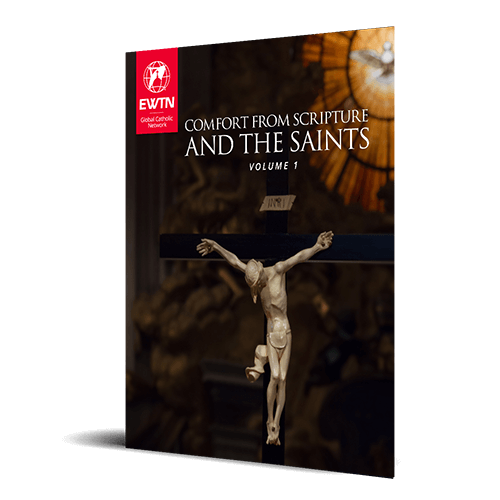
This eBook combines stunning photography from EWTN’s Vatican Bureau along with Bible passages and saints’ quotes that will calm your heart, give you hope, and remind you that God is with us always. Simply fill out the form below and we will send this to you!
Be inspired to follow in the footsteps of the saints. Subscribe to receive the Daily Saint, featuring a brief biography delivered to your inbox each day.
Start now and let the intercession and witness of the saints draw you closer to God.

As we deepen our relationship with the Eternal Word, Jesus Christ, we grow in grace and are transformed by His love and mercy.
STEP 1
We’re here to serve you. Let us help you complete your gift with confidence.

Send a message to Mission Advancement.

Guidance for DAFs, stock, IRA, and more.

Manage your gifts and preferences.