

Your Faith Journey with EWTN
As we deepen our relationship with the Eternal Word, Jesus Christ, we grow in grace and are transformed by His love and mercy.
Died 120 A.D.
Patron Saint of Brescia, Lombardy, Italy

While many Christians went into hiding during Christian persecutions in the early second century, Sts. Faustinus and Jovita, two brothers from Brescia, Italy, boldly proclaimed the Gospel publicly.
St. Faustinus, the elder, was a deacon, and St. Jovita assisted him in evangelizing the people of their region.
After being arrested by Roman authorities, the two brothers stood firm and refused to deny Christ. They endured brutal torments, including scourging and exposure to wild beasts—yet they maintained their resolve.
Witnesses reportedly converted upon seeing the brothers’ courage. Sts. Faustinus and Jovita were beheaded for their faith around the year 120.
The Church in Brescia has honored the courage of these two saints for centuries. Today, their relics are still venerated in the Church of Sts. Faustino and Jovita in the Diocese of Brescia, where they remain the city’s patron saints.
While some information about the two saints has been added through the centuries, the principal ancient source for their martyrdom is the Acts of Faustinus and Jovita, a text known to the early Church. This document has preserved core historical elements of Sts. Faustinus and Jovita’s story, including their preaching and execution. They are also mentioned in early martyrologies and local liturgical calendars that confirm long-standing devotion in Brescia.
The Church of Sts. Faustinus and Jovita (Santi Faustino e Giovita) in Brescia, Italy, stands on the original site of their martyrdom, but has been reconstructed, most recently in the 17th century. It is the city’s most important church after the cathedrals and houses the relics of its patron saints. Previous structures on this site, honoring the two saints, date back to the sixth and ninth centuries, when a church and then a monastery were built. The present Baroque structure was rebuilt starting in 1621. The church features unique art, beautiful architecture, and an elaborate Baroque tomb (Ark) of the saints by Giovanni Antonio Carra, a 17th-century sculptor and architect. It is a significant pilgrimage site.
Several miracles are associated with Sts. Faustinus and Jovita, particularly during their martyrdom. Accounts say their persecutors exposed the two saints to fire and wild beasts, yet they were not harmed. As a result, many pagans converted. In 1438, more than a century after their deaths, a miracle occurred in the city of Brescia, which had become part of the Republic of Venice. The town was being besieged by forces led by Niccolò Piccinino, who sought to reclaim the city under his rule. Having remained outside the city walls for months, the enemy was about to break through the city’s eastern wall during an extended attack when the shining figures of Sts. Faustinus and Jovita reportedly appeared on the city walls, putting the attackers to flight and saving Brescia from conquest.
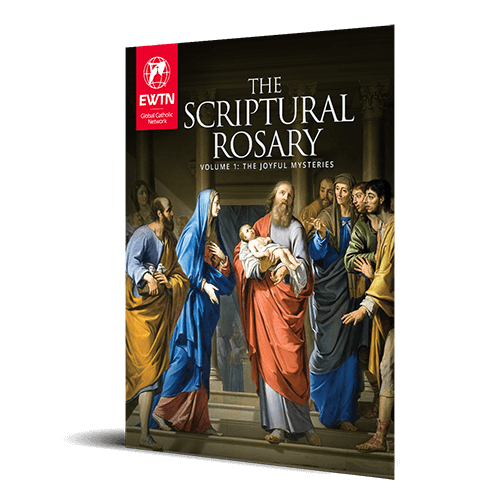
The Holy Rosary is an amazing prayer, encouraged by popes, loved by saints, and prayed by the faithful. At its heart, the Rosary is a meditation on Sacred Scripture, on the lives of Jesus and Mary.
Through this Scriptural Rosary, we hope that you will be able to better meditate on each Hail Mary and deepen your understanding of Sacred Scripture. Use the form below to get your free copy of The Scriptural Rosary.
Be inspired to follow in the footsteps of the saints. Subscribe to receive the Daily Saint, featuring a brief biography delivered to your inbox each day.
Start now and let the intercession and witness of the saints draw you closer to God.

As we deepen our relationship with the Eternal Word, Jesus Christ, we grow in grace and are transformed by His love and mercy.
STEP 1
We’re here to serve you. Let us help you complete your gift with confidence.

Send a message to Mission Advancement.

Guidance for DAFs, stock, IRA, and more.

Manage your gifts and preferences.