

Your Faith Journey with EWTN
As we deepen our relationship with the Eternal Word, Jesus Christ, we grow in grace and are transformed by His love and mercy.
Martyred c. third century

Sts. Hilarius and Tatianus were early Christian martyrs venerated by the ancient Church of Aquileia in the third century, when Christianity spread to the surrounding regions and the persecution of Christians was on the rise in the Roman Empire.
Roman authorities were suspicious of Christians and saw them as a threat to civic unity and loyalty to the empire. It was in this environment that Sts. Hilarius and Tatianus lived and assumed leadership roles in the early Church.
St. Hilarius was to serve as the second Bishop of Aquileia, with the help of St. Tatianus, his deacon, following the death of his predecessor, Hermagoras. They were to continue developing a young and vulnerable Christian community there and proclaiming the Gospel in a pagan region.
Little is known about the lives of these two saints, but tradition holds that Sts. Hilarius and Tatianus were Christians living in Aquileia, a city in northern Italy and a center of political, social, and civic life in the Roman Empire. According to tradition, both men openly professed their Christian Faith and were soon arrested. When commanded to renounce Christ and participate in pagan sacrifices, they refused. Sts. Hilarius and Tatianus were beheaded, along with three other companions.
Sts. Hilarius and Tatianus were venerated locally as powerful intercessors and martyrs for the Faith. Their names, along with their companions, Felix, Largas, and Dionysius, were preserved in early martyrologies, ensuring that their witness would not be forgotten.
Sts. Hilarius and Tatianus stand among the countless unnamed and lesser-known martyrs whose courage sustained the Church during its initial stages of growth and continues to inspire Christians throughout the centuries.
Aquileia was a major Roman city and trade center, connecting Italy with central and eastern Europe. Its strategic location allowed Christianity to spread quickly throughout the region. By the second and third centuries, Aquileia had an established Christian community and later became a prominent patriarchate, hosting various key Church councils. Sts. Hilarius and Tatianus’s martyrdom reflects both the strength of the Faith, from its beginning, and the intensity of the persecution early Christians faced.
The early Church preserved the memory of martyrs through oral tradition, local liturgical celebrations, and written martyrologies. Their names were recorded and commemorated annually on feast days. The faithful sometimes built churches over the burial sites of martyrs, and their relics were venerated as signs of faith and hope in the Resurrection. These practices ensured that the martyrs’ sacrifice remained part of the Church’s living memory. The remains of Sts. Hilarius and Tatianus were preserved and later displayed as “Catacomb Saints” in various European churches after being exhumed from Roman catacombs in the late 16th century.
As deacon, St. Tatianus was St. Hilarius’s right-hand man. Bishops in the early Church usually had deacons assigned as their key assistants, serving as their “right hand” for administration, charity, advising, and even helping to establish and oversee new Church initiatives. The role emerged from the need for assistants to the Apostles, initially focused on charitable work (see Acts 6), but quickly expanded. In the first few centuries, deacons became indispensable, assisting bishops in administration and charity, and even succeeding them in office. Deacons were crucial in supporting the bishop’s growing responsibilities and vital partners for early bishops in the practical, administrative, and pastoral work needed to expand and organize growing Christian churches.
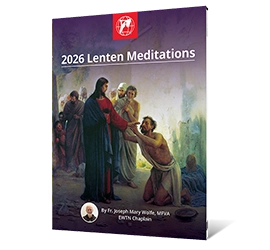
Prepare your soul for the glorious Resurrection with free weekly prayers and reflections from EWTN Chaplain Fr. Joseph Mary Wolfe, MFVA—exploring the healing power of Christ’s love. You’ll also receive weekly emails from Fr. Joseph beginning on Ash Wednesday, continuing each Sunday of Lent and Easter Sunday.
Draw closer to Our Lord as you pause, meditate, and return to Him with your whole heart.
Send me the Physical Pocket Guide
Only available to homes in the U.S.A.
Send me the
eBook
Be inspired to follow in the footsteps of the saints. Subscribe to receive the Daily Saint, featuring a brief biography delivered to your inbox each day.
Start now and let the intercession and witness of the saints draw you closer to God.

As we deepen our relationship with the Eternal Word, Jesus Christ, we grow in grace and are transformed by His love and mercy.
STEP 1
We’re here to serve you. Let us help you complete your gift with confidence.

Send a message to Mission Advancement.

Guidance for DAFs, stock, IRA, and more.

Manage your gifts and preferences.