

Your Faith Journey with EWTN
As we deepen our relationship with the Eternal Word, Jesus Christ, we grow in grace and are transformed by His love and mercy.
Third century
Patron Saints of converts, Christian marriage, prisoners, martyrs

Sts. Valerianus, Tiburtius, and Maximus were early Church martyrs whose lives reveal the transforming power of the Christian Faith during times of persecution. Their story is closely connected to St. Cecilia, one of Rome’s most beloved virgin martyrs.
St. Valerianus, a Roman nobleman, married St. Cecilia, who had consecrated her life to God. Through her gentle witness and unwavering faith, St. Valerianus encountered Christ and was baptized by Pope Urban I. His conversion soon inspired his brother St. Tiburtius, who also accepted the Christian Faith after recognizing the joy and hope it gave believers even in the face of death.
As Christians, Sts. Valerianus and Tiburtius devoted themselves to works of mercy, especially the burial of martyrs. This act of charity, forbidden by Roman authorities, was considered a direct challenge to imperial law. Their faith and public witness led to their arrest and condemnation.
When the brothers were arrested, St. Maximus, a Roman officer, was assigned to guard them. He observed their peace, courage, and trust in God and was moved by their example. He asked to be baptized and openly professed his faith in Christ. This decision sealed his fate. St. Maximus was brutally beaten to death for refusing to renounce his newfound Faith.
Sts. Valerianus and Tiburtius were later executed on the Via Appia, one of Rome’s most important roads and a frequent site of martyrdom. Their deaths strengthened the resolve of the early Christian community and inspired many conversions.
The Church honors Sts. Valerianus, Tiburtius, and Maximus as witnesses to the power of conversion, the sanctity of Christian marriage, and the courage to follow Christ at any cost.
St. Cecilia, the wife of St. Valerianus influenced St. Valerianus’s conversion to Christianity through her example and faith. According to fifth-century legends recorded in the Passio Sanctae Caeciliae, St. Cecilia’s husband and brother-in-law (Valerianus and Tiburtius) were pagans when St. Cecilia married St. Valerianus. Explaining to her husband that she had made a vow of chastity and was protected by an angel, St. Valerianus asked to see the angel. She told him he could only see the angel if the pope baptized him. After being baptized by Pope Urban I, St. Valerianus reported seeing St. Cecilia’s guardian angel and came to believe. St. Valerianus was amazed at the steadfast faith Christians displayed. He converted his brother, St. Tiburtius, and the two brothers went about helping persecuted Christians and burying Christian martyrs, which was unlawful. The two were arrested. St. Maximus, an imperial officer assigned to guard the brothers, witnessed their strong faith and was converted. All three men, as well as St. Cecilia, were martyred for the Faith.
Roman law forbade burying Christian martyrs as a deterrent against the spread of the Faith. By burying martyrs, Christians honored the dead and affirmed belief in the resurrection. Sts. Valerianus and Tiburtius defied Roman law by performing this act of mercy. Under Roman law, the bodies of those executed for the most severe crimes were often denied burial and left exposed as a warning to others. Christians were perceived as dangerous, antisocial, and guilty of treason. After being arrested for breaking the law, the brothers refused to sacrifice to the pagan gods. Their refusal to adhere to the state religion was seen as jeopardizing the pax deorum (peace of their gods), making them enemies of the state.
Tradition holds that Sts. Valerianus, Tiburtius, and Maximus were buried along the Via Appia, near the Catacombs of St. Callixtus. In the eighth century, Popes Gregory III, and Hadrian I restored their tombs and built a church under their patronage, further honoring their burial site. In the ninth century, Pope Paschal transferred their relics to the Basilica of St. Cecilia in Trastevere, where they remain enshrined today. Their names are included in early Christian martyrologies, and they are commemorated together on April 14 as witnesses of faith, conversion, and charity.
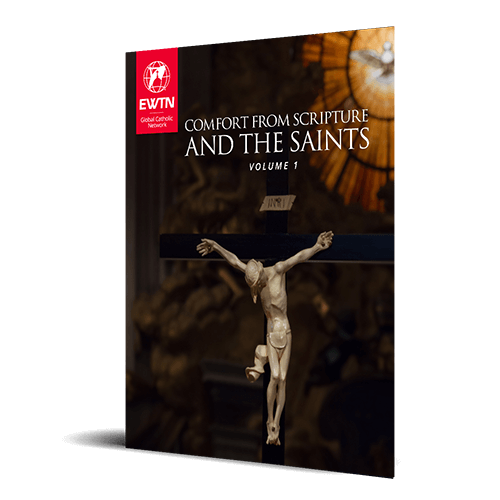
This eBook combines stunning photography from EWTN’s Vatican Bureau along with Bible passages and saints’ quotes that will calm your heart, give you hope, and remind you that God is with us always. Simply fill out the form below and we will send this to you!
Be inspired to follow in the footsteps of the saints. Subscribe to receive the Daily Saint, featuring a brief biography delivered to your inbox each day.
Start now and let the intercession and witness of the saints draw you closer to God.

As we deepen our relationship with the Eternal Word, Jesus Christ, we grow in grace and are transformed by His love and mercy.
STEP 1
We’re here to serve you. Let us help you complete your gift with confidence.

Send a message to Mission Advancement.

Guidance for DAFs, stock, IRA, and more.

Manage your gifts and preferences.